
Crypto Token Development Cost: Types, Process & How to Create a Token
A complete 2026 guide to crypto token development: real cost ranges, token types, blockchain standards (ERC-20, BEP-20, TRC-20, SPL), the step-by-step build process, tokenomics, and how to create your own token.
The complete 2026 playbook: real costs broken down line by line, every token type and blockchain standard, the full build-to-launch process, tokenomics, fundraising, and how to create your own token without overpaying.
Key Takeaways
- A basic standard token (fixed-supply ERC-20, BEP-20, or TRC-20) costs about $500 to $3,000; an advanced token with staking, governance, or DeFi logic runs $8,000 to $30,000+; a compliant security token costs more.
- Total cost is the sum of six parts: design, smart-contract development, audit, deployment gas, listing and liquidity, and ongoing maintenance.
- The blockchain you choose is the single biggest cost lever. BNB Chain, Polygon, Solana, and Tron are far cheaper to deploy on than Ethereum.
- The hard part is not the code, it is the tokenomics, the audit, and the legal classification. Get those wrong and no amount of engineering saves the token.
Quick answer: Crypto token development cost in 2026 ranges from about $500 for a basic standard token to $8,000 to $30,000+ for an advanced token, with compliant security tokens costing more. A token is a smart contract deployed on an existing blockchain (Ethereum, BNB Chain, Solana, Tron, Polygon), so it inherits that network's wallets, exchanges, and security from day one. Final cost depends on the chain, token standard, feature depth, and whether you add an independent audit.
Last updated: September 2026 · Written by the Appinop blockchain team
Tokens are the most capital-efficient product in Web3. You do not build a blockchain; you deploy a smart contract on one that already exists and instantly plug into its wallets, exchanges, and users. That is why tokens now underpin DeFi, gaming, loyalty, fundraising, and real-world assets, and why industry forecasts put the asset-tokenization market in the trillions of dollars this decade.
This is a complete, honest guide. It breaks down exactly what token development costs in 2026, part by part, with two worked examples. It covers every token type and blockchain standard, the full build-to-launch process, tokenomics, fundraising models, exchange listing, security, and the legal questions that decide whether your token is safe to launch. Every number here is a real market range, not sales bait.
Token vs Coin: What You Are Actually Building
Coin
Has its own blockchain (Bitcoin, Ether, BNB). Building one means building or forking a chain: months of work and a large budget.
Token
A smart contract on an existing chain. Cheaper, faster, and it inherits that network's wallets, liquidity, and security. This guide is about tokens.
Almost every project should launch a token, not a coin. You only need your own chain for very specific infrastructure plays, and even then most teams start with a token to validate demand first.
Types of Crypto Tokens
The token type sets the features you need, which sets the cost. These are the ones businesses build most:
Access, payment, or rewards inside a platform. The most common and most affordable type.
Represents equity, debt, or a regulated asset. Needs compliance and permissioned transfers, so it costs the most.
Voting rights in a DAO or protocol. Adds on-chain voting and delegation logic.
Pegged to a fiat currency or asset. Needs reserve, minting, and oracle mechanics.
Unique collectibles or assets on ERC-721 or ERC-1155. A different standard and cost profile.
Community-driven, usually a simple standard token with strong branding and low build cost.
Points and perks for apps and brands. Simple utility mechanics.
Represents real-world assets like property or gold. Overlaps with security tokens on compliance.
Blockchain Standards and Networks Compared
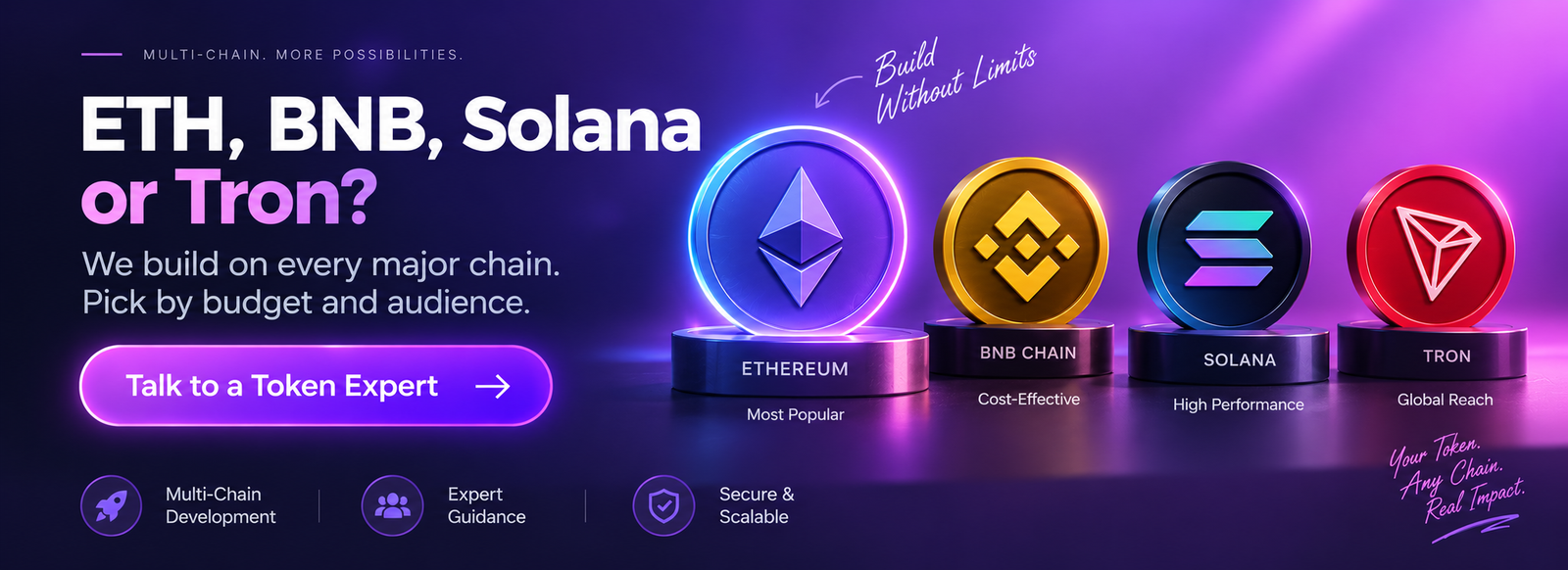
A token standard is the ruleset your contract follows so wallets and exchanges recognise it, defined in open specifications like the Ethereum token standards. It follows from the chain you pick:
| Standard | Blockchain | Best For |
|---|---|---|
| ERC-20 | Ethereum | Fungible utility, governance, and DeFi tokens; the most widely supported standard |
| BEP-20 | BNB Chain | Low-fee utility and community tokens; ERC-20 compatible |
| TRC-20 | Tron | Cheap, high-throughput tokens, popular for payments and stablecoins |
| SPL | Solana | High-speed, low-cost tokens for consumer and gaming apps |
| ERC-721 / ERC-1155 | Ethereum and EVM | NFTs: unique items (721) or mixed fungible and non-fungible (1155) |
| ERC-3643 | Ethereum (permissioned) | Security and regulated asset tokens with built-in compliance |
Which network you deploy on decides both your fees and your audience:
| Network | Deployment Cost | Speed | Best For |
|---|---|---|---|
| Ethereum | High | Moderate | DeFi, governance, security tokens needing maximum trust and liquidity |
| BNB Chain | Low | Fast | Community, utility, and meme tokens on a budget |
| Polygon | Low | Fast | Scalable EVM tokens with Ethereum compatibility |
| Solana | Very low | Very fast | High-volume consumer, gaming, and payment tokens |
| Tron | Very low | Fast | Payments and stablecoins with high throughput |
ERC-20 vs BEP-20: Which Standard Should You Pick?
These are the two most common choices, and they differ mainly on cost, speed, and ecosystem. Both are fungible-token standards and are broadly compatible, so some projects launch on both.
| Factor | ERC-20 (Ethereum) | BEP-20 (BNB Chain) |
|---|---|---|
| Deployment gas | ~$150 to $800 (varies with load) | ~$5 to $30 |
| Transfer fee | Higher, up to dollars per transfer at peak | Very low, cents per transfer |
| Speed | Moderate block times | Fast block times |
| Ecosystem | Largest DeFi, liquidity, and tooling | Large, lower-cost, retail-heavy |
| Best for | DeFi, governance, institutional trust | Community, utility, budget launches |
Rule of thumb: pick ERC-20 when liquidity and credibility matter most, and BEP-20 when low fees and fast, cheap transactions matter more. A BEP-20 build typically lands 40 to 60 percent cheaper overall, mostly from gas. Gas figures are approximate and move with network demand.
Crypto Token Development Cost in 2026
There is no single price, because a token is a bundle of choices. Start with the tier that matches your ambition, then read the component breakdown below to see where the money actually goes.
| Token Tier | Cost | Timeline | What You Get |
|---|---|---|---|
| Basic token | $500 - $3,000 | 2-5 days | Standard ERC-20 / BEP-20 / TRC-20, fixed supply, name, symbol, deployment |
| Standard utility token | $3,000 - $8,000 | 1-2 weeks | Mint / burn, pausable, tax or fee logic, basic tokenomics, testnet and mainnet |
| Advanced token | $8,000 - $30,000+ | 3-6 weeks | Staking, governance, vesting, reflections, DeFi integrations, custom logic |
| Security token (STO) | $25,000 - $50,000+ | 6-12 weeks | ERC-3643 compliance, KYC / whitelist transfers, investor controls, legal wiring |
Cost Breakdown by Component
Every quote is really these six line items. Ask any vendor to itemise them:
| Component | Typical Cost | What It Covers |
|---|---|---|
| Token design & tokenomics | $500 - $4,000 | Use case, supply, allocation, vesting, utility, and economic modelling |
| Smart contract development | $500 - $20,000 | Writing and configuring the contract and its features |
| Security audit | $5,000 - $15,000 | Independent third-party review before mainnet |
| Deployment & gas | $50 - $5,000 | Network fees, far higher on Ethereum than BSC, Polygon, or Solana |
| Listing & liquidity | variable | DEX liquidity pool, plus optional centralized exchange listing fees |
| Maintenance & support | from $300 / mo | Monitoring, upgrades, and new features after launch |
Two Worked Examples
Community token on BNB Chain
A BEP-20 utility token with mint / burn and a small transaction fee.
Governance token on Ethereum
An ERC-20 with staking, on-chain voting, and multi-round vesting.
What Drives the Cost
- Blockchain and gas: Ethereum deployment costs far more than BNB Chain, Polygon, or Solana. A BNB-based token typically costs 40 to 60 percent less than the Ethereum equivalent.
- Feature depth: a fixed-supply token is cheap; staking, governance, vesting, reflections, and anti-bot logic each add smart-contract work.
- Security audit: a token audit runs roughly $5,000 to $15,000 (far more for complex DeFi) and is non-negotiable before a public launch.
- Tokenomics complexity: multi-round vesting, treasury logic, and dynamic fees take real design and testing time.
- Team rate: the biggest lever. An experienced offshore blockchain team ships the same audited contract that Western agencies bill several times more for.

Token Generator vs Professional Development
Free token generators and no-code makers can mint a basic token in minutes. They are fine for a quick test, but rarely safe for a real launch. The honest trade-off:
| Factor | Free token generator | Professional development |
|---|---|---|
| Cost | Free or a small fee | From $500, scaling with features |
| Custom features | Limited to presets | Any logic: staking, vesting, governance |
| Security audit | None | Independent audit before launch |
| Ownership & support | Little to none | Full source, docs, and ongoing support |
| Investor trust | Low | High, with verified, audited code |
Use a generator to prototype an idea. For anything that will hold real value, raise money, or list on an exchange, a professional, audited build is the only responsible choice.
How to Create a Crypto Token: Step by Step
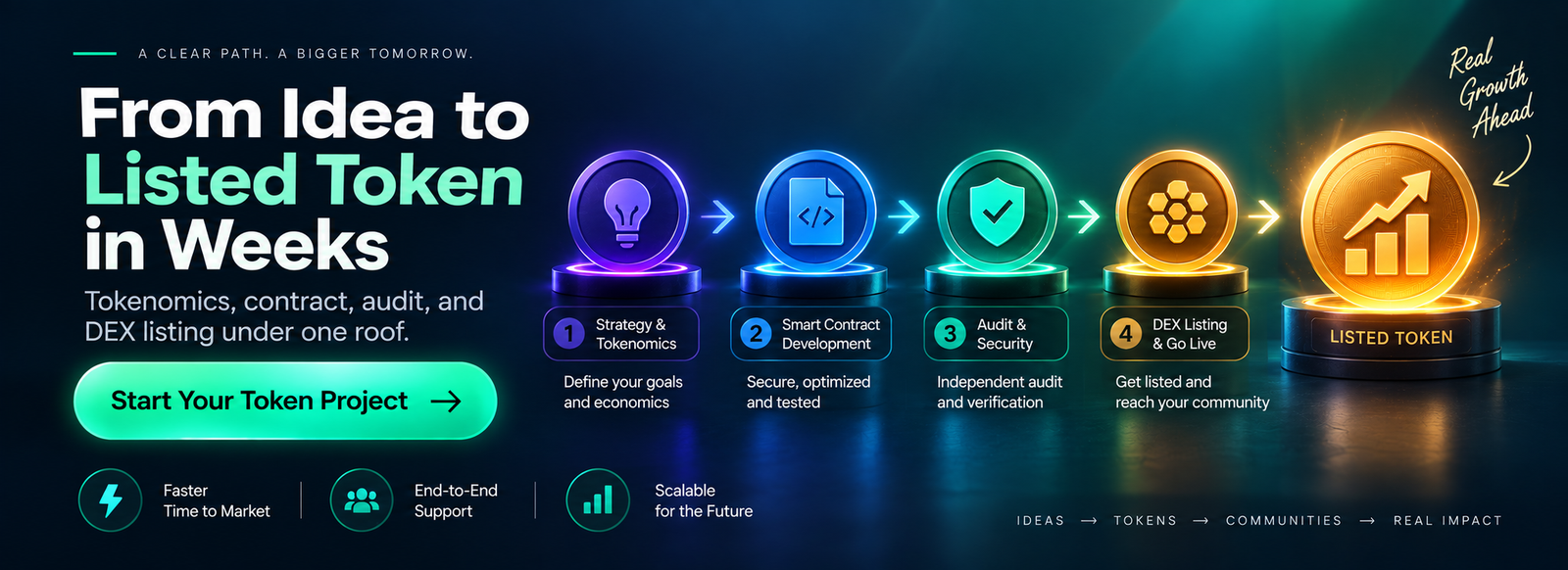
Whether you build in-house or hire a token development company, a professional launch follows the same eight steps:
Decide what the token does and why anyone needs it: utility, governance, security, reward, or stablecoin. This single decision drives every later choice.
Set total supply, allocations, vesting schedules, utility, and any burn or reward mechanics. Model it before you code it.
Match the chain to your budget and audience, and pick the matching standard (ERC-20, BEP-20, TRC-20, SPL).
Write and configure the contract with your features on audited libraries such as OpenZeppelin, never homegrown cryptography.
Deploy to a test network and run functional and edge-case tests until it behaves perfectly, before spending real gas.
Commission an independent security review and fix every finding. This is what makes the token investable.
Launch the audited contract, then publish and verify the source code on the block explorer for transparency.
Seed a DEX liquidity pool, integrate wallets, pursue exchange listings, and maintain the token after launch.
Tokenomics: The Part That Actually Matters
Tokenomics is what separates a token that compounds from one that collapses. A sample allocation for a community-first launch looks like this:
- Total supply: fixed or inflationary, and the exact cap.
- Allocation: splits across community, liquidity, team, investors, and treasury.
- Vesting: lock-ups and release schedules that prevent early dumps and build trust.
- Utility: the concrete reasons people need to hold and use the token.
- Burn and rewards: mechanics that manage supply and incentivise long-term holders.
How to Fund a Token Launch
If you are raising capital with the token, the model you choose affects cost, compliance, and reach:
| Model | What It Is | Best For |
|---|---|---|
| ICO | Public sale direct to buyers from your own site | Maximum control, higher marketing and compliance burden |
| IEO | Sale run through a centralized exchange | Built-in audience and trust, exchange fees apply |
| IDO | Launch via a decentralized launchpad and DEX | Fast, community-driven raises with instant liquidity |
| STO | Regulated security-token offering | Compliant equity or asset raises, highest legal cost |
Planning a full raise or a broader ecosystem? See our ICO development services and NFT marketplace development.
Exchange Listing and Liquidity
A token nobody can trade is worthless, so launch always includes getting it liquid:
- DEX liquidity pool: pair your token with a base asset (such as ETH, BNB, or a stablecoin) on Uniswap, PancakeSwap, or similar so it is instantly tradable.
- Liquidity locking: lock the pool for a set period to reassure holders and reduce rug-pull fear.
- Centralized exchange listing: optional and often costly, but expands reach; approach it once the token has traction.
- Market making: keeps spreads tight and trading healthy on larger listings.
Security and Audit Checklist
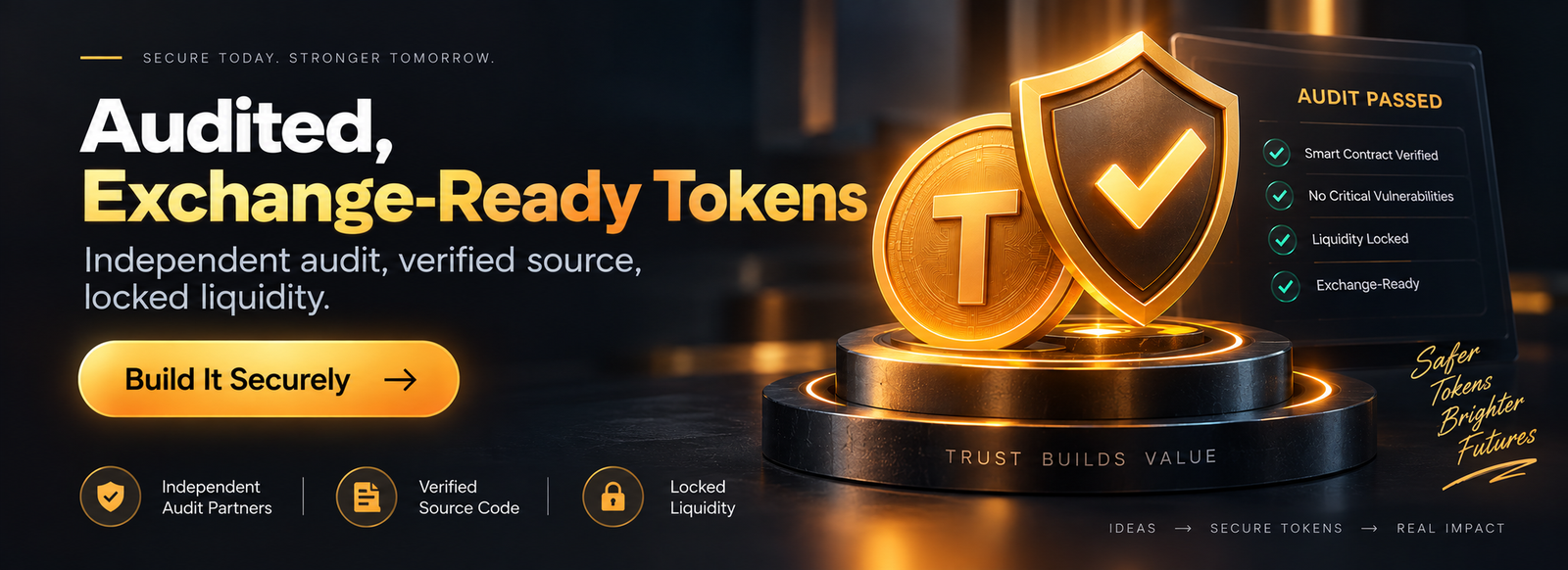
A token contract controls real money, so security is the product, not a feature:
- Audited libraries: build on battle-tested standards like OpenZeppelin, never custom cryptography.
- Independent audit: a third-party review before mainnet is the single best protection against exploits.
- Verified source code: publish and verify the contract on the block explorer so holders can trust it.
- Ownership controls: use a multisig or renounce ownership where appropriate to reduce rug-pull risk.
- Locked liquidity and vesting: on-chain proof that the team cannot dump or drain the pool.
Legal and Compliance by Region
Whether a token is a utility or a security is a legal question, not a technical one, and the answer changes by jurisdiction:
| Region | Key Framework | What to Watch |
|---|---|---|
| United States | SEC, Howey test | Tokens promising profit from others' efforts are likely securities |
| European Union | MiCA | Unified rules for issuers, disclosures, and stablecoins |
| UAE | VARA (Dubai) | Licensing for issuance and virtual-asset activity |
Important: a token that promises returns from a team's efforts is likely a security and carries real obligations, wherever you launch. Confirm your token's classification with qualified counsel before you go live. This guide is informational and not legal advice.
Timeline: From Idea to Launch
Standard contract configured, tested, and deployed. Fastest possible route to a live token.
Custom features, tokenomics, testnet, and mainnet with a DEX pool.
Staking, governance, or DeFi logic, plus an independent audit before launch.
Compliance wiring, investor controls, legal review, and a regulated offering.
Common Token Development Mistakes
How to Choose a Token Development Company
The right partner is the difference between a token that launches clean and one that gets exploited. Vet every vendor on these:
- Proven track record: real launched tokens and verifiable on-chain contract addresses, not just claims.
- Security-first process: audited libraries and a mandatory independent audit before mainnet.
- Multi-chain expertise: genuine experience across Ethereum, BNB Chain, Solana, Tron, and Polygon.
- Tokenomics capability: they help design the economics, not just write the code.
- Transparent, itemized pricing: a line-by-line quote across all six cost components.
- Post-launch support: listing help, monitoring, and maintenance after go-live.
Why Build Your Token With Appinop
Most agencies either overcharge for a template or underinvest in security. We do neither. We ship audited, exchange-ready tokens across every major chain, price every component transparently, and support you from tokenomics through listing.
- Full-stack delivery: tokenomics, smart contract, audit coordination, deployment, liquidity, and listing under one roof.
- Any chain: Ethereum, BNB Chain, Solana, Tron, and Polygon.
- Security-first: audited libraries, independent review, verified source, and locked liquidity.
- Itemized pricing: a line-by-line quote you can hold us to, backed by 10+ years in blockchain engineering.
Related reading: our token development services, the ERC-20 token development cost breakdown, the crypto wallet development cost guide, and cryptocurrency exchange development.
Build Your Crypto Token With Appinop
From a simple utility token to a fully custom, audited, exchange-ready build, we ship secure tokens on Ethereum, BNB Chain, Solana, Tron, and Polygon. Tell us your idea and get an itemized quote in 48 hours.
Start Your Token ProjectReady to Build Your Project?
Get expert consultation from our team of 50+ specialists.
Related Topics

Experts on staff
Years building products
UAE · India
Clients delivered globally
Frequently Asked Questions
Related Articles
ERC-20 Token Development Cost: Full 2026 Breakdown
RWA Tokenization in Dubai: VARA Licensing, Cost & Platform Development (2026)
How to Start a Crypto Exchange in the USA (2026): Licensing, Costs, and Launch Roadmap
Ready to Start Your Project?
Our team of 50+ experts is ready to help you build exceptional digital products.