
How to Build an AI App Builder Like Lovable: Cost, Architecture & Teardown
A product teardown of how an AI app builder like Lovable works: the agent generation loop, sandbox architecture, token economics, growth engine, seven failure modes that kill clones, and what it costs to build your own from $20K to $80K+.
Lovable made non-programmers ship real applications by describing them in plain English, and turned that trick into roughly $500 million in annual recurring revenue in about two years. This is a teardown of how an AI app builder actually works: the illusion the user experiences, the machinery underneath it, the token economics that decide whether the business survives, and the blueprint for building your own.
An AI app builder turns prompts into working full-stack apps through a loop: an agent plans the app, generates code into one opinionated stack, runs it in a sandbox with live preview, repairs its own errors, and deploys with one click. The build is five systems: agent orchestrator, codegen pipeline, sandboxed execution, integrations, and credit billing. A focused vertical builder ships in 10 to 14 weeks, from about $20,000; full custom platforms run $40,000 to $80,000+.
That last figure is the entire strategy chapter of this teardown compressed into one number. The market is not developers who want faster tools. It is the hundreds of millions of people with an app idea and no way to build it, two-thirds of Lovable's users come from outside tech entirely: education, retail, healthcare, real estate. Hold that thought until chapter five.
The illusion: what the user experiences
The product experience is a conversation. No editor, no terminal, no repository. It looks like this:
✓ A booking page with stylist and service selection
✓ A calendar with available time slots
✓ Stripe deposits at checkout
✓ An admin dashboard for your team
Preview is live on the right. What would you like to change?
Ninety seconds after the first message there is a working application on screen. And the second act matters as much as the first, every following message edits the live app:
The user never sees code unless they ask. That felt-magic, in both the first build and the hundredth edit, is the whole product, and everything in the next chapter exists to protect it.
The machinery: what actually happens
The economics: where every message's money goes
In this category, cost of goods sold is a design decision. Every user message triggers model tokens across the whole loop, and your routing, caching, and repair efficiency set your gross margin as surely as your pricing does. Roughly, one "build me an app" message spends like this:
The revenue side is subscriptions with credit metering: a free tier with daily limits that acts as viral top-of-funnel (Lovable's 100K daily projects are marketing, not cost), paid tiers from roughly $20 to $100 a month with larger allowances, then hosting fees per deployed app, team and enterprise tiers, and white-label licensing. The winners route simple edits to cheap models and reserve frontier models for architecture, cache aggressively, and measure cost per user per day the way an exchange measures latency. Price credits below your true token cost and growth bankrupts you.
One more economic layer the headlines miss: an economy is forming on top of these platforms. Lovable-built projects already attract around 5 million visits a day across the web, and a cottage industry of agencies now charges real money to build and polish apps on vibe-coding platforms for clients who will not prompt it themselves. That secondary market is direct evidence for the white-label and vertical plays in chapter five: the demand for "someone build this for me, with AI speed" is proven and paying.
The growth engine: how it acquired 8 million users
The distribution machine is as engineered as the product, and every mechanism is copyable for your own vibe coding platform:
- Every deployed app is an advertisement. Free-tier projects carry a "Built with Lovable" badge on a platform subdomain. With 100K projects a day and 5 million daily visits to them, the user base does the marketing: the badge loop is the cheapest acquisition channel in SaaS.
- Templates are SEO. Hundreds of indexable template and showcase pages ("CRM template," "booking app template") catch exactly the searches of people about to build something, then one click drops them into the generator.
- The free tier is the funnel, not a cost. Daily message limits create a habit and a queue; the upgrade happens the day the user's project starts mattering to them.
- Build-in-public virality. Non-technical founders love posting "I built this in an afternoon" screenshots; the product is designed to produce those moments in the first session.
The battlefield: who is fighting for vibe coding
| Platform | Audience | The lesson it teaches |
|---|---|---|
| Lovable | Non-technical builders | One constrained stack and zero visible code is what makes amateurs succeed |
| Cursor | Professional developers | Pros and amateurs are different products; do not chase both at once |
| Replit | Learners through pros | Owning the runtime and hosting deepens both lock-in and margins |
| Bolt.new | Prototypers | In-browser execution (WebContainers) slashes infrastructure cost per user |
| v0 by Vercel | Front-end teams | A narrow wedge, UI only, still builds a huge funnel into a paid platform |
| No-code (Bubble, Webflow) | The previous era | Drag-and-drop still had a learning curve; prompting removed it, which is why vibe coding is eating no-code's market |
That last row answers the question every founder asks: how is this different from no-code? Bubble and Webflow replaced code with visual editors, but users still had to learn the editor, think in databases and workflows, and invest weeks. Vibe coding replaced the editor with a sentence. The skill floor dropped to "can describe what you want," which is why 80% of Lovable's users are non-technical and why the no-code generation of tools is now racing to bolt AI on before their market finishes migrating.
The openings: where a new builder wins
Remember the number from the top: two-thirds of Lovable's users come from outside tech, and Lovable serves them all with one generic product. That is the gap. Five plays, in order of how directly they exploit it:
Vertical builders. "The app builder for restaurants." "For real estate agencies." "For gyms." Domain templates, industry integrations (POS, MLS, booking engines), and marketing in the niche's own vocabulary out-convert a generalist every time, and the vertical's users are already on Lovable proving the demand.
What that concretely looks like: imagine "RealtyBuilder", an app builder for real estate agencies. Templates for listing sites, open-house booking, and buyer portals; MLS and DocuSign integrations pre-wired; agency branding baked in; prompts that understand "add a mortgage calculator to every listing." Priced at $199/month against the $20 generalist, because it saves an agency a $20K custom build. That product is a 12-week project on the blueprint below, and its equivalent exists in every vertical you can name.
Enterprise internal tools. Companies want vibe coding behind their firewall: private model options, SSO, audit logs, deployment in their own cloud. Consumer-DNA giants leave this open, and enterprise pays 10x consumer prices.
Agency white-label. Thousands of agencies want to sell "AI-built apps" under their own brand with client management and margin. A B2B2C platform play the consumer products ignore entirely.
Non-English markets. Vibe coding in Hindi, Arabic, Spanish, or Bahasa, with local payment rails and local templates. The localization gap every global product leaves behind, again.
Regulated-industry builders. HIPAA-conscious healthcare generation, finance-grade compliance defaults. Hardest to build, nearly impossible for generalists to retrofit, and priced accordingly.
The failure modes: where clones die
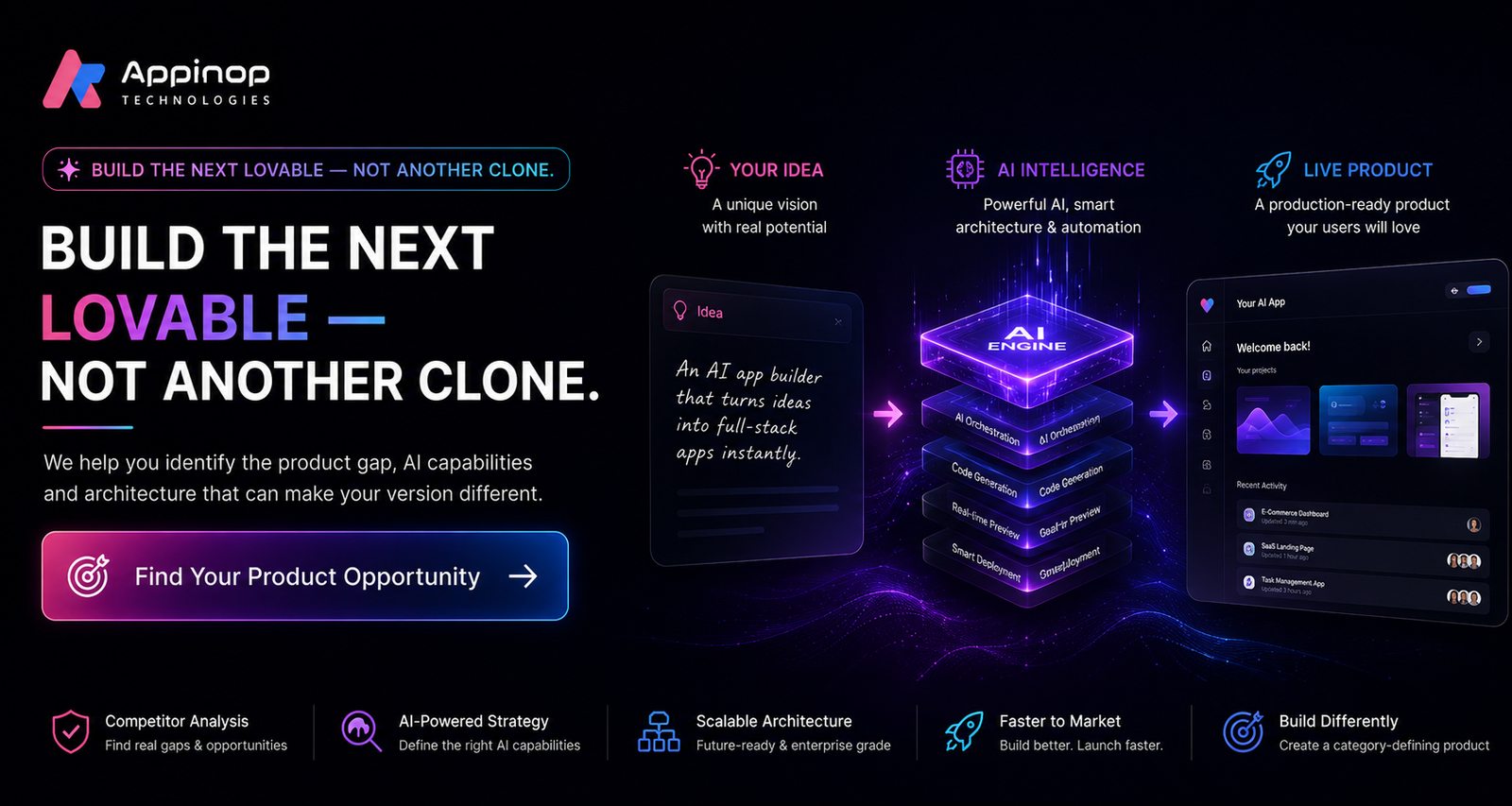
The graveyard of "Lovable clones" is already large, and the causes of death repeat. Learn them before you spend:
Death by red error screen. Teams budget for generation and skimp on the repair loop, so users watch their app crash and leave. The invisible fix cycle needs more engineering than the first-pass generation, not less.
Death by growing project. Demos of a 5-file to-do app work everywhere; the 50-file real product is where coherence collapses. Without repo maps, retrieval over the codebase, and diff-based edits, the agent starts breaking what it built last week, and users notice immediately.
Death by token bill. Flat pricing over frontier-model loops is a subsidy to your heaviest users. More than one platform has grown itself into negative gross margin and then died raising the next round.
Death by sandbox breach. You are executing millions of pieces of untrusted, machine-written code. Weak isolation eventually runs a crypto miner, attacks a third party, or leaks data, and one incident ends the platform's credibility.
Death by insecure output. Your non-technical users ship apps holding real customer data. If generated apps default to open databases and hardcoded secrets, their breach is your headline. Secure-by-default templates (row-level security, sanitized inputs, managed secrets) are an obligation and a differentiator.
Death by vibes-only quality. "It seemed to work in testing" is not a metric. Serious platforms run evaluation suites, hundreds of real prompts scored on build success and functional correctness, against every model and prompt change. Without evals, every improvement is a guess.
Death by platform dependency. Your entire product runs on someone else's models. Providers reprice, rate-limit, and deprecate on their schedule, not yours. Survivors keep every model call behind their own interface, run continuous evals across at least two providers, and can reroute traffic in a config change instead of a rewrite.
The blueprint: what you build, and what it costs
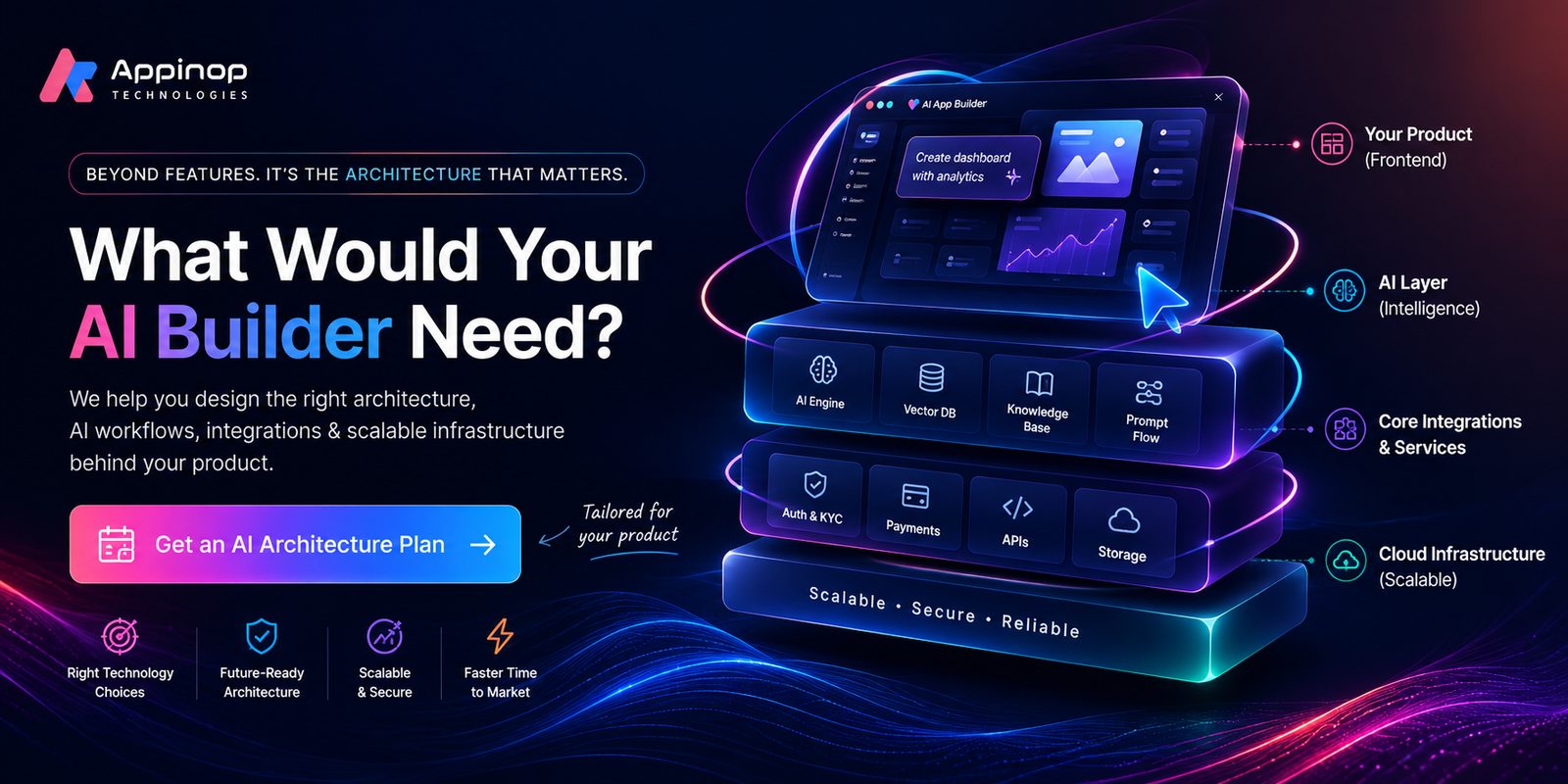
The spec sheet for the whole platform reads as five systems plus the metering that keeps them honest:
Timeline: weeks 1-2 define the niche and the opinionated stack; weeks 3-6 build the generation core with the repair loop; weeks 7-9 add integrations and deploy; weeks 10-12 wire billing, run the evaluation suite, and harden the sandbox; weeks 13-14 launch, with 20-30 niche templates rather than a blank prompt box, because "start from this and make it yours" converts several times better than "describe anything."
Assemble or build? The honest starting-point decision. Open-source scaffolds and agent frameworks (the GPT-Engineer lineage, open clone repos, orchestration libraries) can stand up a demo in weeks and are fine for validating a niche. But every failure mode in chapter six lives in the parts the scaffolds do not include: the repair loop, project-scale context handling, sandbox hardening, and metering. The pragmatic route we recommend: assemble the commodity pieces, and custom-build the four systems that decide survival, exactly the split a good development partner prices for you.
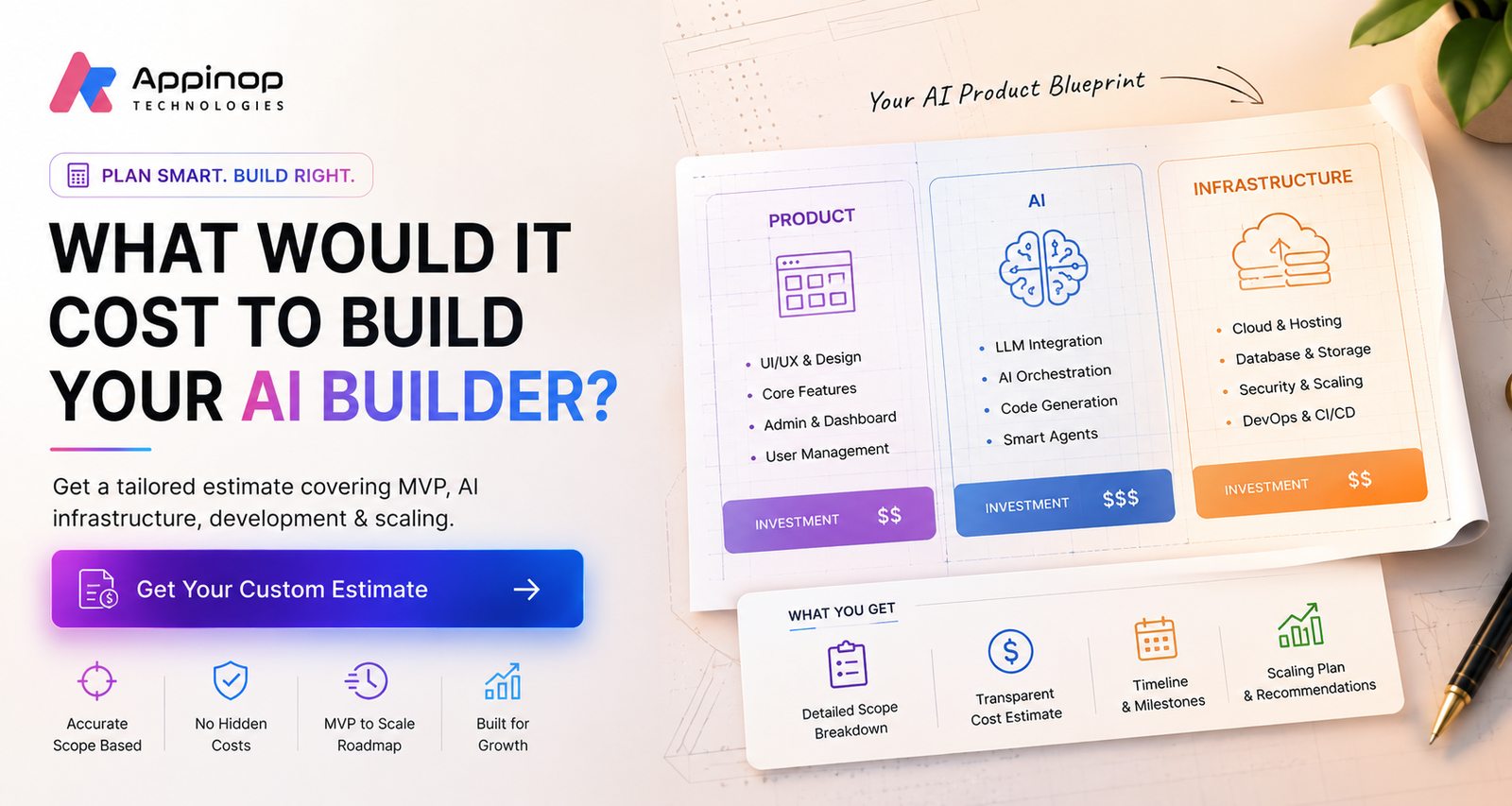
Cost: the drivers are how much of the loop you build versus assemble, the sandbox architecture (in-browser is cheaper to run, microVMs are more capable), integration depth, and evaluation infrastructure. Honest anchors: a focused vertical builder from around $20,000; a full custom platform with self-healing generation, secure sandboxing, and credit billing at $40,000 to $80,000+. Model spend is a real ongoing operating line, design your margins around it from day one.
Who builds this with you
An AI app builder is the deepest AI engineering product there is: agent orchestration, code generation, secure execution of untrusted code, and unit economics that live or die on token efficiency. Appinop builds this stack end to end: AI agent development for the orchestrator, generative AI development for the codegen pipeline, SaaS platform engineering for billing and multi-tenancy, and full-stack AI development across the product. For the architecture principles underneath, our AI integration guide covers the service-layer discipline this category demands, and our AI development companies guide maps the partner landscape.
I. Vibe coding is the fastest-growing category in software history, $500M ARR in two years, built on 80% non-technical users, and the demand curve is still vertical.
II. The product is a loop, not a model: plan, generate into one constrained stack, run in a sandbox, self-heal, deploy. The invisible repair loop is the moat.
III. Token economics are the business model: routing, caching, and repair efficiency set gross margin as surely as pricing does.
IV. Do not clone the generalist; own a vertical, an enterprise, a language, or a regulated industry, and budget $40K-80K+ for a platform that can hold real users.
Ready to Build Your Project?
Get expert consultation from our team of 50+ specialists.
Related Topics

Experts on staff
Years building products
UAE · India
Clients delivered globally
Frequently Asked Questions
Related Articles
Ready to Start Your Project?
Our team of 50+ experts is ready to help you build exceptional digital products.