
How to Build an App Like Snabbit: Cost, Features & Quick Home Services Model (2026)
A practical 2026 guide to building an app like Snabbit: the quick home services dispatch model, the customer, Expert, and operations apps, unit economics and the supply side, gig-worker compliance in India, three simple cost packages from $2,000, and how a new entrant competes with Snabbit, InstaHelp, and Pronto.
How to build an app like Snabbit in 2026: what a 10-minute house help app is actually made of, the dispatch model that makes it quick commerce for people rather than a marketplace, the supply side that is the real moat, honest cost in three simple packages, compliance for gig and domestic workers in India, and how a new entrant competes with Snabbit, Urban Company InstaHelp, and Pronto.
Key Takeaways
- An app like Snabbit is quick commerce for domestic help: trained, verified professionals dispatched from dense micro-zones to arrive in about 10 minutes, booked by duration rather than by task. It is a dispatch system with three apps (customer, Expert, operations), not a browse-and-book marketplace.
- The category has arrived. Snabbit crossed 1 million jobs in a month in March 2026 and is raising at about a $400 million valuation; Urban Company's InstaHelp passed 1 million monthly bookings the same month; Pronto is scaling on venture money. Demand is proven; the question is execution.
- Our 2026 packages: MVP $2,000 to $3,000, Complete Clone $3,500 to $5,000, Custom Build $5,000 to $10,000. Supply recruitment, hubs, and marketing are separate.
- The software is the easy part. Supply density, training, worker retention, and safety decide whether the 10-minute promise holds, and India's new gig-worker and domestic-worker laws now shape how you build the workforce.
Quick answer: Building an app like Snabbit costs about $2,000 to $3,000 for an MVP (customer app, Expert app, admin, duration-based booking, zone dispatch, payments), $3,500 to $5,000 for a Complete Clone with live tracking, OTP check-in, verification and shift workflows, and $5,000 to $10,000 for a Custom Build to your own design with dispatch optimisation, subscriptions, a second service vertical, and multi-city operations tooling. Launch runs from 3 to 10 weeks depending on the package.
The final number depends on how many service verticals you launch, the sophistication of the dispatch and zone logic, real-time tracking depth, the training and verification workflow, and how much operations tooling your city teams need.
Last updated: September 2026 · Written by the Appinop product team
India spent a decade learning to order groceries in ten minutes. The next thing it learned to order was a person: someone trained and verified who arrives at the door in about the time it takes to make tea, cleans the kitchen, does the dishes, folds the laundry, and leaves. Snabbit built the best-known version of that experience, went from launch in 2024 to more than a million jobs in a single month by March 2026, and is now raising at a valuation around $400 million. Urban Company's InstaHelp and Pronto are racing it. When founders ask how to build an app like Snabbit, they are really asking how to build a quick-commerce dispatch business for domestic help, and that is a different thing from the on-demand marketplaces of the last decade. This guide covers the product, the operating model, the supply side, the real cost, the compliance layer, and how a new entrant wins a city. Whether you are searching for a Snabbit clone app, a Snabbit clone script, on-demand house help app development, or a maid booking app built from scratch, the decisions are the same and every path is covered below.
What an App Like Snabbit Actually Is
Strip away the branding and house help app development comes down to a hyperlocal dispatch system with three products sharing one operations backbone:
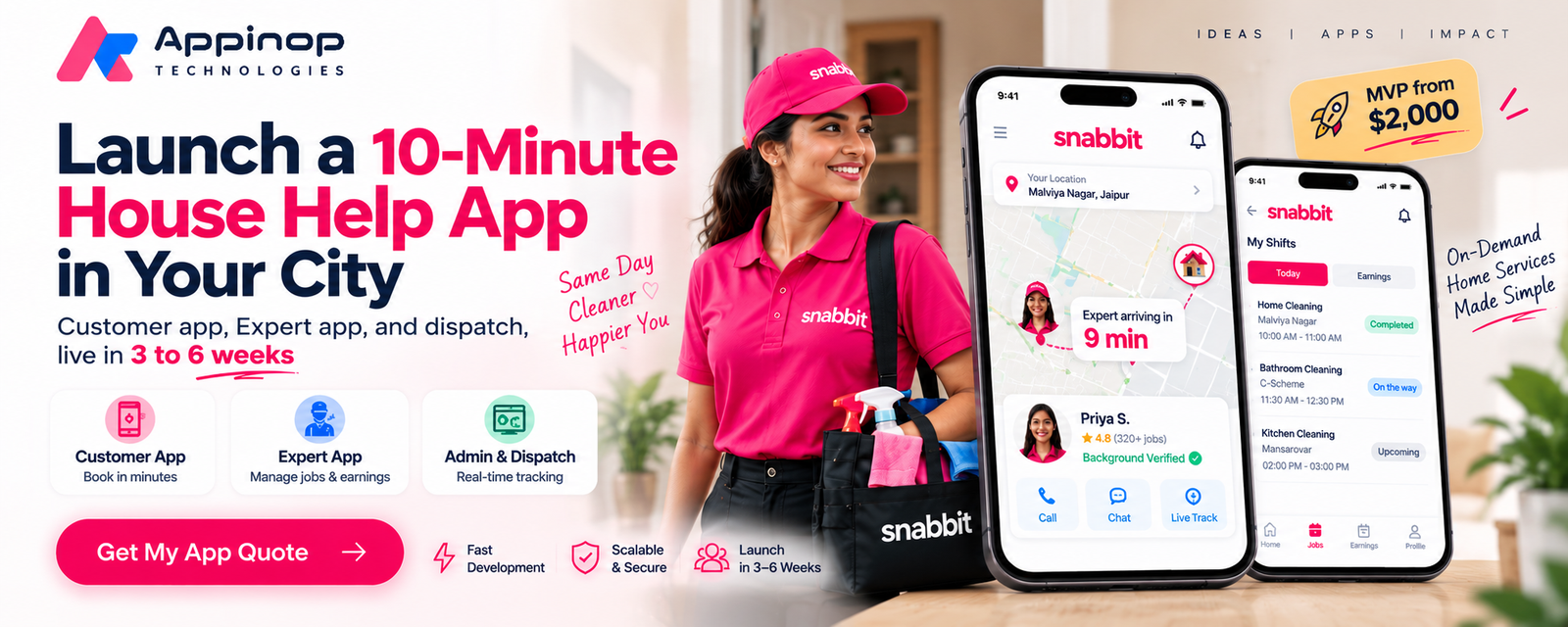
Choose a service, pick instant or scheduled, select a duration (30 minutes to 3 hours), see the price, confirm, watch the Expert arrive on a map, share a check-in OTP, rate, and rebook a favourite.
Shift and zone check-in, job offers and acceptance, navigation, OTP check-in and timer, task checklist, earnings and incentives, training modules, support and SOS.
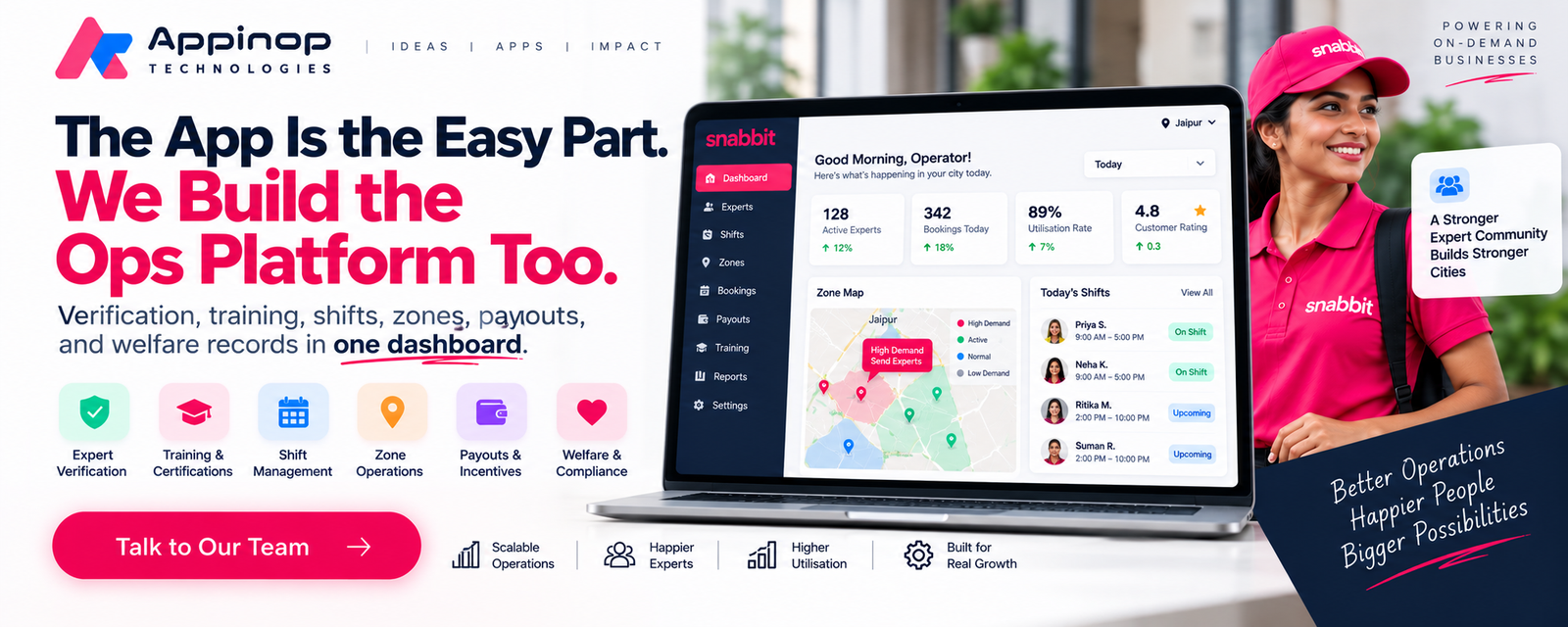
Micro-zone management, supply forecasting, shift planning, dispatch rules, recruitment and verification pipeline, training and quality scores, pricing and promotions, disputes, analytics.
The defining choice is booking by duration, not by task. The customer buys 60 minutes of a trained person's time and can ask for dishes, dusting, and laundry in that hour. That removes the quoting, haggling, and scope disputes of task-based marketplaces, makes pricing transparent, and lets the dispatch engine treat supply as interchangeable capacity in a zone. Combined with a managed (not freelance-browse) workforce, it is why the model behaves like a dark store for people: dense supply near demand, instant fulfilment, and utilisation as the number that matters.
The India Opportunity, and the Hard Truth
Three forces line up. First, demand: dual-income urban households, nuclear families, and a generation that already orders everything on demand and finds the informal maid market (unreliable, unverified, opaque pricing) frustrating. Second, habit: quick commerce trained users to expect 10-minute fulfilment and to pay for it. Third, supply: a very large pool of domestic workers, overwhelmingly women, for whom a platform that offers training, predictable shifts, safety, and better earnings is a real upgrade on the informal market.
The numbers show the category is past the experiment stage. In March 2026 Snabbit completed more than 1 million jobs in a month, up from about 10,000 jobs a day the previous October, and Urban Company reported that InstaHelp, its quick housekeeping vertical, crossed 1 million monthly delivered bookings across five metros, calling it the fastest-scaling unit in the company's history. Industry estimates for February 2026 put InstaHelp at roughly half the segment, Snabbit at a bit over a third, and Pronto at around 14 percent.
The hard truth is the operating model. Ten-minute arrival only works where supply is dense enough that an available Expert is always within a few hundred metres of the next booking. That means launching micro-zone by micro-zone, staffing shifts ahead of demand, paying for idle time in the early weeks, and holding onto trained workers when a competitor offers a bigger incentive. The app is necessary; the operating discipline is what separates the three players above from the dozens of on-demand home service apps that never got past a pilot.
How a 10-Minute House Help App Works, Step by Step
The customer picks a service (house help, cook, and later salon or care), instant or scheduled, and a duration from 30 minutes to 3 hours. The price is fixed per duration, with discounted super-saver slots in off-peak hours to smooth demand.
The engine matches the booking to an on-shift, available Expert in the customer's micro-zone, ranked by distance, rating, and continuity (a customer's previous favourite gets priority). The Expert accepts and starts moving; the customer sees a live ETA.
At the door the customer shares a check-in OTP, which starts the timer, confirms identity, and creates an auditable record of the session start. The same works when someone books on behalf of a parent or a tenant.
The Expert follows a task checklist, the customer can add tasks within the time, and the app handles extensions. Support and SOS are one tap away for both sides.
The timer ends, payment settles (prepaid via UPI or wallet, or post-paid), the customer rates and can mark the Expert as a favourite for next time, and the platform records quality data that feeds dispatch ranking and training.
Snabbit by the Numbers
| Metric | Figure | Why it matters for your build |
|---|---|---|
| Founded | 2024, Bengaluru | From zero to a million-job month in about two years: the model scales fast once zones are dense |
| Jobs | 1M+ in March 2026; ~10,000 a day in October 2025 | Dispatch, payments, and support must be built for volume from the start |
| Workforce | 15,000+ registered professionals; an all-women workforce as of late 2025 | Recruitment, training, and safety are core product surfaces, not back-office |
| Cities | Mumbai, Navi Mumbai, Thane, Pune, Bengaluru, Hyderabad, Delhi, Gurugram, Noida, Ghaziabad | Launch city by city, zone by zone; multi-city ops tooling comes with the Custom Build |
| Pricing | From about ₹99 an hour; duration slots from 30 minutes to 3 hours; super-saver off-peak pricing | Duration-based, transparent pricing with demand smoothing built into the price list |
| Funding | $30M at a $180M valuation (Oct 2025); raising about $50M at ~$400M (Apr 2026) | Investors are funding supply density and city expansion, not just the app |
| Ratings | Rated 4.8+ by 240,000+ families (company figure) | Quality scoring and favourites drive retention; build them into dispatch |
Core Features of an App Like Snabbit
| Area | Must-have features |
|---|---|
| Customer app | Phone or OTP login, saved addresses with map pin, service and duration selection, instant or scheduled booking, transparent price with super-saver slots, live ETA and tracking, check-in OTP, add tasks and extend time, UPI, cards, and wallet, ratings and favourites, booking history, referrals, support chat |
| Expert app | Onboarding and document upload, training modules and quizzes, shift and zone check-in, job offers with accept and decline, navigation, OTP check-in and timer, task checklist, earnings, incentives and payouts, attendance and leave, SOS and support, ratings feedback |
| Dispatch engine | Micro-zone geofences, availability and shift state, distance and ETA scoring, favourite-first and rating-weighted matching, batching for scheduled bookings, reassignment on cancellation, surge and capacity controls |
| Operations platform | Zone and hub management, supply forecasting versus demand, shift planning, recruitment pipeline and verification status, training and certification, quality and complaint handling, pricing and promo management, payouts and reconciliation, analytics dashboards |
| Trust and safety | Background verification, ID and address checks, OTP check-in, session tracking, SOS for both sides, insurance, blocking and reporting, audit logs |
| Notifications and engagement | Push and WhatsApp updates for booking states, reminders for scheduled slots, rebook nudges, subscription and plan offers |
Modules and When to Add Them
| Module | What it does | When to add |
|---|---|---|
| Home cook | Meal preparation by duration, cuisine preferences, grocery handling rules | After house help is dense in a city; the leader added it in one city first |
| Subscriptions and plans | Daily or weekly recurring slots, plan pricing, pause and reschedule | Early; recurring bookings are the retention engine and smooth supply planning |
| Salon and beauty at home | Skilled services with kits and longer durations | Later; different training, kit logistics, and pricing |
| Elderly and child assistance | Companionship, non-medical care, longer shifts | Later; higher verification bar and insurance |
| B2B and co-living | PGs, co-living operators, small offices booking recurring capacity | Once utilisation dips are visible; fills off-peak hours |
| Corporate benefits | Employers subsidising house help for staff | With a sales motion in place |
| Multi-city ops suite | Cross-city analytics, central recruitment, franchise or partner hubs | At the second or third city; included in the Custom Build |
Business Model and Unit Economics
The model earns on the difference between what the customer pays per hour and what the Expert earns per hour, net of the cost of keeping supply available. Every design choice in the product exists to push utilisation up:
- Duration-based pricing: fixed prices per slot (30, 45, 60, 90, 120, 180 minutes) make the offer simple and make revenue per Expert-hour predictable.
- Super-saver slots: discounted off-peak hours move demand into the troughs so on-shift Experts stay busy instead of idle.
- Subscriptions: daily or weekly recurring slots lock in demand you can staff against, and lift lifetime value.
- Expert pay and incentives: per-job pay plus attendance and rating bonuses, with shift guarantees in new zones while demand builds.
- Add-ons and verticals: cooking, deep cleaning, and later salon or care carry higher prices per hour on the same supply and dispatch base.
A worked illustration: a zone with 50 on-shift Experts averaging 5 paid hours a day at an average ₹150 per hour is ₹37,500 a day in gross bookings; at 60 percent to the Expert and 40 percent to the platform, that is ₹15,000 a day of platform revenue per zone before incentives, hubs, and support. Push paid hours from 5 to 6 with subscriptions and off-peak pricing and platform revenue rises 20 percent with no new supply. That is why utilisation, not downloads, is the metric that decides this business.
The Supply Side: The Real Moat
Any competent team can build the customer app. The companies winning this category built a workforce operation first and an app around it. If you build an app like Snabbit, plan for these as product surfaces, not afterthoughts:
| Area | What it involves |
|---|---|
| Recruitment | Local sourcing in the neighbourhoods you will serve, referrals from existing Experts, community partners, and a pipeline you can see in the ops platform by stage |
| Verification | Identity and address checks, police verification where available, reference checks, and a status the dispatch engine respects (no unverified Expert ever gets a job) |
| Training and certification | A short academy covering cleaning standards, kitchen hygiene, laundry care, customer conduct, and app use, with quizzes and certification tracked per skill |
| Shifts and zones | Fixed shifts in assigned micro-zones so supply is where demand is, with hubs or waiting points near dense residential clusters |
| Earnings and dignity | Predictable pay, weekly payouts, uniforms and kits, safety protocols, grievance channels, and recognition; the informal market offers none of these, and that gap is why workers join and stay |
| Quality loop | Ratings, complaint categories, re-training triggers, and favourite rates feeding back into dispatch ranking and incentives |
Retention is the number to watch. A trained Expert who leaves after a month takes her onboarding cost and her customer favourites with her. The platforms that keep workers do it with predictable income, safety, and respect, and they measure it as closely as they measure customer retention.
The Zone Math: What 10 Minutes Actually Requires
A 10-minute arrival means the next available Expert is within about a kilometre on foot or a two-wheeler, so a launch micro-zone is roughly 2 to 3 square kilometres of dense residential housing. An illustrative launch zone:
| Input | Illustrative value | Note |
|---|---|---|
| Zone size | 2 to 3 km² | Apartment clusters; avoid zones split by highways or rail lines |
| Peak demand | 25 bookings an hour, 7 to 10 am and 5 to 8 pm | Morning and evening peaks; troughs in between |
| Average slot | 60 minutes plus 10 minutes travel and handover | About 0.85 bookings per Expert-hour at full utilisation |
| Experts on shift at peak | 30 to 35 | 25 bookings an hour divided by 0.85, plus a buffer for cancellations and no-shows |
| Roster for the zone | 50 to 60 | Two shifts, leave, and attrition cover |
| Week-one idle cost | Shift guarantees for 30 Experts while demand builds | Budget this as a launch cost; it is the price of the promise |
Demand in a new zone starts below supply, so the first weeks are paid for with shift guarantees and filled with super-saver pricing and society tie-ups. Utilisation climbs as favourites and subscriptions build, and only then does the next zone open. That sequence, zone by zone, is the whole playbook.
Trust, Safety, and Compliance in India
A stranger enters a home, and a worker, often a woman, enters a stranger's home. Both sides need protection, and Indian law is catching up with platform work fast:
| Area | What it means for your app |
|---|---|
| Customer safety | Verified Experts only, OTP check-in, visible profile and rating, session tracking, blocking and reporting, and insurance for damage or loss |
| Worker safety | SOS in the Expert app, live location during sessions, customer ratings of behaviour, the right to decline and leave, and a support team that responds in minutes |
| Gig and platform worker law | The Code on Social Security, 2020 defines gig and platform workers and provides for aggregator contributions (in the range of 1 to 2 percent of turnover, subject to caps) toward social security. Karnataka's Platform Based Gig Workers (Social Security and Welfare) Act, 2025 adds registration, a welfare fee of 1 to 5 percent of payouts, and transparency obligations, and other states are following |
| Domestic worker law | Karnataka's Domestic Workers (Social Security and Welfare) Bill, 2025 aims to register and protect domestic workers, including replacement and gig helpers. Design registration, records, and contributions into the ops platform now rather than retrofitting |
| Data protection | Home addresses, entry OTPs, and worker identity documents are sensitive under the Digital Personal Data Protection Act: consent, encryption, minimal retention, and breach notification |
| Payments and tax | UPI and cards through an RBI-authorised gateway, GST on platform fees, TDS on worker payouts where applicable, and clean records for welfare contributions |
Important: this guide is informational, not legal, tax, or financial advice, and all costs shown are indicative estimates rather than quotes. Gig-worker and domestic-worker rules vary by state and are changing quickly; confirm your obligations with qualified counsel before launch.
Cost to Build an App Like Snabbit
Keep it simple: pick one of three packages. Each price covers everything listed in its row, from an experienced Indian product team, and each package includes the one below it:
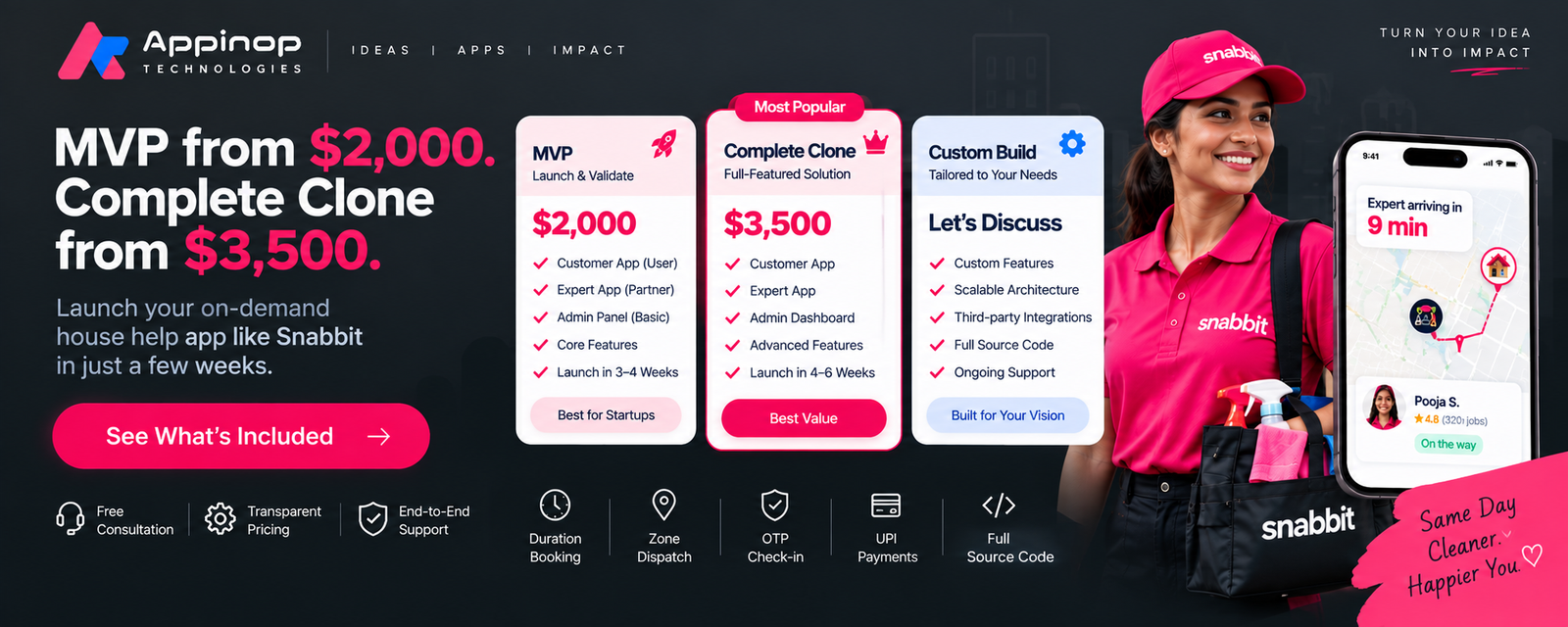
| Package | Cost | Timeline | What You Get |
|---|---|---|---|
| MVP | $2,000 - $3,000 | 3-4 weeks | Customer app (Android and iOS), Expert app, admin panel, duration-based instant and scheduled booking, zone-based dispatch to the nearest available Expert, UPI and card payments, ratings and favourites, notifications |
| Complete Clone | $3,500 - $5,000 | 5-6 weeks | Everything in the MVP, as a complete Snabbit-style platform: live tracking and ETA, OTP check-in and timer, add tasks and extend time, super-saver slot pricing, verification and training workflows, shift and zone management, incentives and payouts, referrals and promos, support tooling |
| Custom Build | $5,000 - $10,000 | 8-10 weeks | Everything in the Complete Clone, built to your own brand and flows, plus dispatch optimisation (favourite-first, rating-weighted, batching), subscriptions and plans, a second service vertical such as home cook, supply-versus-demand dashboards, multi-city operations tooling, and B2B booking |
Which Package Is Right for You
You want to test the 10-minute model in a few zones of one city with real bookings and real Experts, at the lowest possible cost.
You want the full Snabbit-style experience (tracking, OTP, super-saver pricing, verification, shifts, payouts) ready to run a managed workforce properly in one city.
You want your own brand and flows, subscriptions, a second vertical, smarter dispatch, and the operations tooling to expand to more zones and cities.
What Sits Outside the Package
- Supply: recruitment, training, uniforms and kits, shift guarantees in new zones, and welfare contributions are operating costs and usually the largest line in the first year.
- Hubs and city operations: waiting points, city managers, and support staff.
- Marketing and acquisition: the first bookings in a zone come from hyperlocal marketing, referrals, and society tie-ups.
- Third-party fees: maps, SMS and WhatsApp, verification providers, payment gateway charges, and cloud hosting.
Two reference points: a single-city house help launch is an MVP or a Complete Clone; a two-vertical platform with subscriptions and multi-city tooling is a Custom Build. Ask us for an itemised quote for your exact scope.
Tech Stack for a Quick Home Services App
| Layer | Common choices | Why |
|---|---|---|
| Mobile apps | Flutter or React Native for customer and Expert apps; native modules for background location | One codebase, two apps, reliable tracking |
| Backend | Node.js or Go services, PostgreSQL with PostGIS, Redis for availability and queues, WebSockets for live state | Geo-queries, real-time dispatch, booking state machine |
| Dispatch | Rule and score based matching in micro-zones; batching for scheduled slots; later, demand forecasting models | Start simple, tune with data |
| Maps and ETA | Google Maps Platform or Mapbox or Ola Maps for geocoding, routing, and ETA | Accurate arrival times are the product promise |
| Payments | Razorpay, Cashfree, or PayU with UPI, cards, and wallet; payout APIs for Experts | UPI conversion, weekly payouts |
| Verification | ID and address verification APIs, police verification workflows, document storage with encryption | Trust on both sides |
| Notifications | Firebase Cloud Messaging, SMS, WhatsApp Business API | Booking states, reminders, rebook nudges |
| Ops and analytics | React admin, Metabase or Superset, event pipeline for utilisation and quality metrics | Zone, shift, and quality decisions in near real time |
| Infrastructure | Kubernetes or managed containers, multi-AZ, observability, backups | Uptime during morning and evening peaks |
How to Build an App Like Snabbit: 8 Steps
Whether you start from the MVP, the Complete Clone, or a Custom Build, a successful launch follows the same sequence:
Dense residential areas with dual-income households and apartment complexes. The 10-minute promise depends on density, so start narrow.
Shifts, zones, pay structure, incentives, training curriculum, verification standard, safety protocols, and the welfare obligations in your state. The app is built around this, not the other way round.
Match the package to your budget and timeline. The MVP gets you to a live zone fastest; the Complete Clone runs a managed workforce properly; the Custom Build gives you your own brand and deeper ops tooling.
Customer app, Expert app, operations platform, duration pricing, zone dispatch, tracking, OTP check-in, payments, and ratings.
Sign and certify 30 to 60 Experts for the launch zones before opening to customers, with shift guarantees so supply is on the ground on day one.
Verification gates in dispatch, OTP and SOS, insurance, DPDP consent and data handling, payout and welfare records, and support playbooks.
Rehearse bookings end to end in the launch zones: ETA accuracy, tracking on low-end Android, OTP flow, extensions, cancellations, and peak-hour load.
Open a few zones, watch arrival time, paid hours per Expert, rebook rate, and retention on both sides, then add zones, subscriptions, and a second vertical as the numbers hold.
Timeline: From Decision to First Bookings
Branding, zone and pricing configuration, payments, first cohort recruited in parallel, launch in a few zones.
Adds tracking, OTP check-in, super-saver pricing, verification and training workflows, shifts, incentives, and payouts.
Your design, dispatch optimisation, subscriptions, second vertical, supply-demand dashboards, multi-city tooling, B2B.
The Competitive Landscape
| Player | Position | Note |
|---|---|---|
| Urban Company InstaHelp | Segment leader by volume | 1M+ monthly bookings in March 2026 across five metros; backed by a listed company's brand, supply, and balance sheet |
| Snabbit | Fastest-scaling independent | 1M+ jobs in March 2026, ten cities, raising at about $400M; duration pricing, a women-only workforce as of late 2025, home cook expansion |
| Pronto | Venture-backed challenger | Roughly 14 percent estimated share in February 2026; raising at about $200M |
| Traditional on-demand apps | Task-based marketplaces | Browse, quote, schedule for later; slower, less standardised, being displaced in metros |
| Informal market | The real incumbent | Word of mouth, unverified, opaque pricing; still most of the market outside metros |
The shape of the market: three funded players fighting in five to ten metros, and the rest of urban India still served by the informal market. That is where the opening is.
Snabbit vs Urban Company InstaHelp vs Pronto
| Factor | Snabbit | Urban Company InstaHelp | Pronto |
|---|---|---|---|
| What it is | Pure quick home services company, founded 2024 | Quick housekeeping vertical inside a listed, broad home services marketplace | Venture-backed quick house help startup |
| Booking model | By duration, 30 minutes to 3 hours; instant or scheduled | Quick housekeeping tasks (cleaning, dishes, laundry, meal prep) booked on demand | Short on-demand house help slots |
| Arrival promise | About 10 minutes | 10 to 15 minutes | Minutes, in dense zones |
| Pricing | From about ₹99 an hour; super-saver off-peak slots | Per-task and per-slot pricing inside the Urban Company app | Competitive per-slot pricing |
| Workforce | Managed, trained, verified; women-only as of late 2025; 15,000+ registered | Draws on Urban Company's partner network and training | Managed, trained workforce |
| Footprint | Ten cities across Mumbai region, Pune, Bengaluru, Hyderabad, Delhi NCR | Mumbai, Bengaluru, Delhi NCR, Hyderabad, Pune | Metro focus, expanding |
| Scale, March 2026 | 1M+ jobs in the month | 1M+ monthly delivered bookings | Roughly 14 percent estimated segment share in February |
| Backing | Raising about $50M at ~$400M valuation (Lightspeed, Bertelsmann, Susquehanna) | Listed parent company | Raising at about $200M valuation |
For a founder the differences matter less than the similarities: all three sell time from a managed workforce, dispatch from dense zones, and compete on arrival time and trust. Build for that model and pick the market they are not in.
How to Compete With Snabbit, InstaHelp, and Pronto
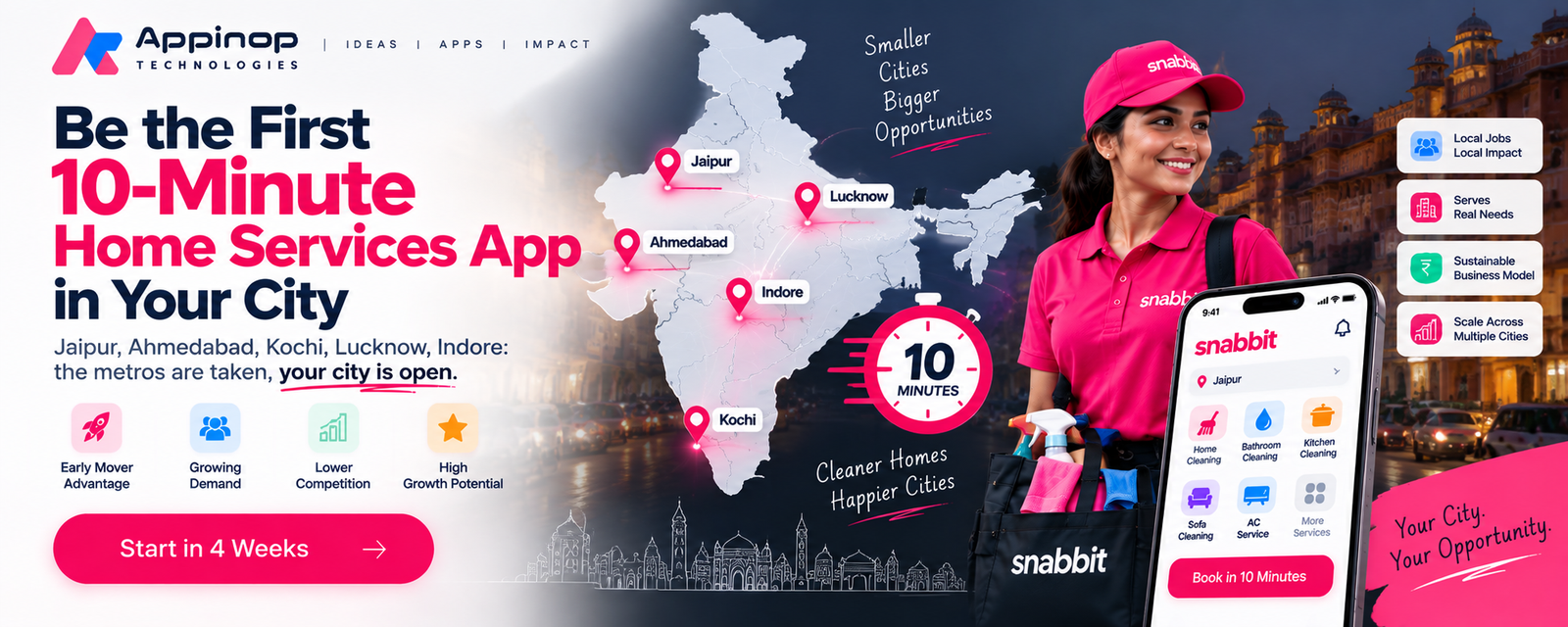
Tier 1 outskirts and tier 2 cities (Ahmedabad, Jaipur, Kochi, Chandigarh, Lucknow, Indore) have the same dual-income households and no 10-minute option yet. Density is easier to reach in a compact city.
Home cooking, elderly companionship, or post-natal support with deeper training and a higher price per hour than general house help.
Better retention through predictable income, safety, and respect gives you supply the leaders are fighting over. Workers move to the platform that treats them best.
Co-living operators, PGs, serviced apartments, and small offices buy recurring capacity that fills off-peak hours and stabilises utilisation.
Common Mistakes When Building a House Help App
Pre-Launch Checklist
- Micro-zones drawn and loaded; dispatch only offers jobs inside them
- Verification gate enforced in dispatch; no unverified Expert can receive a job
- OTP check-in, timer, extension, and cancellation flows tested end to end
- SOS routed to a staffed line for both customers and Experts
- Tracking tested on low-end Android with background location
- Payments, refunds, and Expert payouts reconciled on a test cycle
- First cohort of 30 to 60 Experts recruited, verified, and certified
- Shifts, hubs or waiting points, and shift guarantees set for launch zones
- Pricing, super-saver slots, and launch promos configured
- Insurance in place; gig-worker and domestic-worker registrations started for your state
- DPDP consent, privacy policy, and data retention rules live
- Support playbooks for damage, no-shows, and conduct complaints ready
Quick Home Services Glossary
| Term | Meaning |
|---|---|
| Micro-zone | A small geofenced area, usually 2 to 3 km², inside which Experts are staffed and jobs are dispatched so arrival stays within about 10 minutes. |
| Duration-based booking | Selling a block of an Expert's time (30 minutes to 3 hours) rather than a specific task, so multiple chores fit one booking at a fixed price. |
| Utilisation | Paid hours divided by on-shift hours per Expert; the metric that decides whether the model is profitable. |
| Super-saver slot | A discounted off-peak booking window used to move demand into hours when supply would otherwise sit idle. |
| Favourite-first dispatch | Matching logic that offers a booking to the customer's previously rated favourite Expert before the nearest available one. |
| Check-in OTP | A one-time code the customer shares at the door to confirm identity and start the session timer. |
| Shift guarantee | A minimum payment to an on-shift Expert regardless of bookings, used in new zones while demand builds. |
| Managed workforce | Experts recruited, trained, verified, and scheduled by the platform, as opposed to freelancers who list themselves on a marketplace. |
| Rebook rate | The share of customers who book again within a period; with favourites, the strongest retention signal in this category. |
More in This Series
This guide is the hub of our quick home services cluster. The companion guides below go deeper on each question and will be linked here as they publish: Home Services App Development Cost in 2026; Urban Company Clone App: Features, Cost and Model; Cleaning Service App Development Cost in India; How Much Does It Cost to Build an App Like Snabbit; and How to Start a House Help Startup in India.
Why Build Your Home Services App With Appinop
As an on-demand app development company based in India, we handle domestic help app development, home services app development, and dispatch, tracking, and marketplace products for the Indian market, including cleaning service apps and laundry apps, and we build quick home services platforms the way this guide describes: workforce model first, dispatch built for density, trust and compliance wired in, and package pricing with full source ownership. From a $2,000 MVP for a single-city launch to a Custom Build with multi-city tooling, we deliver the customer app, the Expert app, and the operations suite, and we stay with you after launch.
Related reading: our guides to building an app like DoorDash and building an app like Airtasker, our AstroTalk app guide for another India-first marketplace, the complete mobile app development guide, and our mobile app development services.
Disclaimer: Snabbit, Urban Company, InstaHelp, and Pronto are trademarks of their respective owners. Appinop Technologies is not affiliated with, endorsed by, or connected to any of them. "Clone" in this guide refers to replicating the functionality of an app, not its brand, code, or trademarks. Company figures are from public announcements and press reports; segment shares are third-party estimates; all cost figures are indicative 2026 estimates and not legal, tax, or financial advice.
Build Your Quick Home Services App With Appinop
Tell us your city, your services, and your budget, and get an itemised quote in 48 hours, with MVP, Complete Clone, and Custom Build options side by side.
Get My App QuoteReady to Build Your Project?
Get expert consultation from our team of 50+ specialists.
Related Topics

Experts on staff
Years building products
UAE · India
Clients delivered globally
Frequently Asked Questions
Related Articles
How to Build a Super App Like Gojek in Southeast Asia: Cost, Features & Guide
How to Build an App Like DoorDash in the USA: Cost, Features & Guide (2026)
How to Build an App Like Airtasker in Australia: Features, Model & Cost
Ready to Start Your Project?
Our team of 50+ experts is ready to help you build exceptional digital products.