
How to Build an App Like Urban Company in 2026: Cost, Features, Business Model & Tech Stack
A side by side guide to building an app like Urban Company (formerly UrbanClap): how the marketplace works, what it earns, the features, the tech stack, and what an MVP, Complete Clone, or Custom Build costs in 2026.
Urban Company, formerly UrbanClap, is the reference point for every home services marketplace in India: more than 7.8 million annual customers, close to 60,000 active service partners, over twenty categories from salon at home to appliance repair, a September 2025 stock market listing, and ₹1,556 crore of revenue in FY26. Founders who ask how to build an app like Urban Company are usually asking two questions at once: what is the platform actually made of, and can a new entrant still win against a listed leader with ₹2,000 crore in cash? This guide answers both, side by side: the leader on the left, your version on the right, all the way from model to features to cost. Whether you call it an Urban Company clone app, an UrbanClap clone (many people still search the old name), or Urban Company app development from scratch, the decisions are the same and every path is covered here.
An app like Urban Company is a multi-category home services marketplace: customers browse verified partners, book a slot, pay in-app, and rate; partners onboard, get trained, accept jobs, and earn; an admin platform runs categories, pricing, quality, and payouts. Building one costs $2,000 to $3,000 for an MVP, $3,500 to $5,000 for a Complete Clone, and $5,000 to $10,000 for a Custom Build from an experienced Indian team, and launches in 3 to 10 weeks. The leader's own numbers show the model works; the opening for a new app is a city, a category, or a partner experience the leader serves less well.
Last updated: September 2026 · Appinop product team
At a Glance: Urban Company and an App Like It
- Founded 2014 as UrbanClap; rebranded 2020; listed on NSE and BSE in September 2025
- Multi-category marketplace: salon and spa, cleaning, pest control, appliance repair, plumbing, electrical, carpentry, painting, and more
- 7.8 million annual transacting users; about 59,500 monthly active partners
- India plus UAE and Singapore; Native brand of water purifiers and smart locks
- InstaHelp: a 10 to 15 minute housekeeping vertical crossing 1 million monthly bookings
- FY26 revenue ₹1,556 crore; net transaction value ₹4,290 crore
- One city, two to four categories, launched in 3 to 10 weeks
- Customer app, partner app, and admin platform on one backend
- 50 to 150 verified partners recruited before the app opens
- Scheduled booking with fixed prices; instant booking where supply allows
- Commission model with optional subscriptions and product sales later
- Build cost $2,000 to $10,000 by package; the leader's ₹2,000 crore is not needed to win a city
Urban Company in 2026: The Numbers That Matter for Your Build
The leader publishes its numbers now, which gives a new entrant something rare: a proven benchmark for what the model produces at scale.
| Metric | Figure | What it tells you |
|---|---|---|
| Revenue, FY26 | ₹1,556 crore, up 36 percent | Home services marketplaces monetise well once dense; the take rate on services runs high |
| Net transaction value, FY26 | ₹4,290 crore, up 31 percent | Roughly ₹1 of revenue for every ₹2.75 of services booked, including product sales |
| Annual transacting users | 7.8 million (Q3 FY26) | Repeat customers, not downloads, are the asset; design for rebooking |
| Monthly active partners | About 59,500 (Q3 FY26) | Supply is the moat; training, verification, and earnings decide who stays |
| Core India marketplace | Adjusted EBITDA positive; ₹44 crore profit in Q3 FY26 | The marketplace model is profitable at scale |
| InstaHelp | 1.61 million orders in Q3 FY26; adjusted EBITDA loss ₹61 crore that quarter | The managed quick-service model buys growth with heavy investment first |
| Net result, FY26 | Loss of ₹234.8 crore, driven by InstaHelp investment | Profitable marketplace, expensive quick-service push: two different businesses under one brand |
| Cash | About ₹2,095 crore | The leader can outspend anyone in its metros; compete where it is not |
Two things stand out. The classic marketplace, where customers choose a partner and book a slot, is profitable. The 10-minute managed vertical is growing faster but losing money while it builds density. That split is the most useful strategic fact in this guide, and it decides which model you should build first.
Marketplace vs Managed Quick Service: The Two Models Side by Side
Urban Company runs both models today. A new app should pick one to start with, and the choice shapes every feature and every rupee of the budget.
- Customer chooses: browses partners, ratings, and prices, then books a slot, usually for later today or another day
- Many categories: salon, cleaning, repairs, painting; each with its own pricing and skills
- Partners are independent: trained and verified by the platform, accept jobs they want, bring their own kits in most categories
- Revenue: commission on each job plus consumables, products, subscriptions, and training fees
- Economics: profitable at moderate density; no shift guarantees; supply scales with demand
- Weak spot: partner cancellations, quality variance, slower fulfilment
- Platform dispatches: customer books a duration, the nearest on-shift professional arrives in about 10 minutes
- Few categories: house help, cleaning, dishes, laundry, cooking
- Workforce is managed: shifts, zones, uniforms, training academy; the platform guarantees supply
- Revenue: per-hour margin plus subscriptions and off-peak pricing
- Economics: needs dense zones and shift guarantees first; loses money until utilisation climbs
- Weak spot: heavy operating cost per city; a thin zone breaks the promise
For most founders the marketplace is the right first build: it is cheaper to operate, profitable sooner, and covers more categories. Our guide to building an app like Snabbit covers the managed model in depth if that is your bet.
How an App Like Urban Company Works, Customer and Partner Side by Side
- Discover: pick a category, see packages and prices, filter by rating, time, and availability
- Book: choose a slot, add address and notes, pay in-app or choose pay after service
- Get matched: the platform assigns a verified partner or offers the job to nearby partners; the customer sees who is coming
- Service: partner arrives, starts the job with an OTP or check-in, completes a checklist, adds approved extras
- Close: payment settles, the customer rates, and the app nudges a rebook or a plan
- Onboard: apply, upload ID and documents, pass a background check, complete category training and a skills test
- Go live: set availability, service areas, and categories; see earnings potential per job
- Accept work: receive job offers with time, place, and payout; accept or decline; navigate to the customer
- Deliver: check in, follow the checklist, request extras, mark complete
- Earn: see earnings and ratings, get paid on a schedule, buy consumables and kits at partner rates
Features of an App Like Urban Company
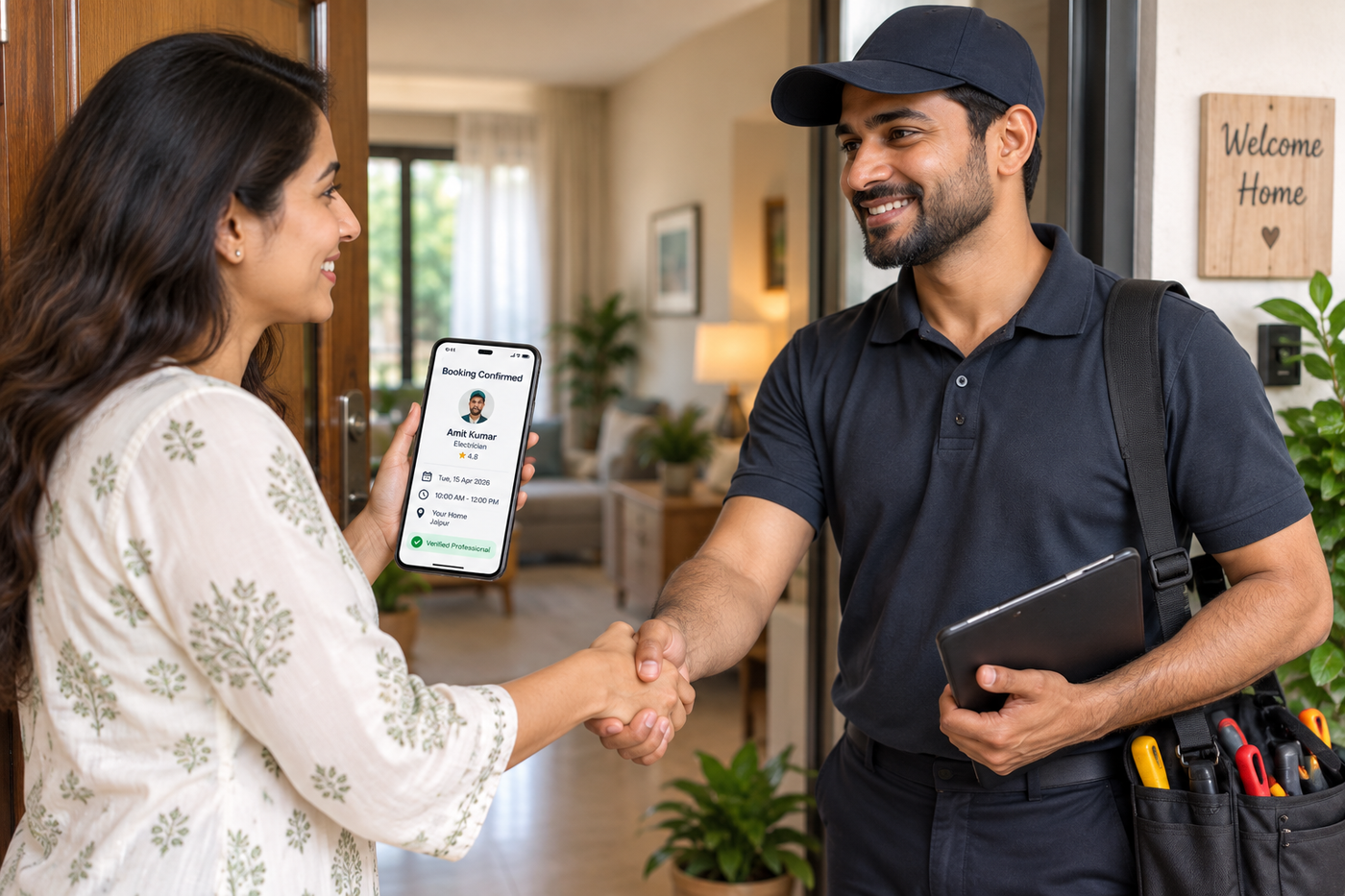
A home services app like Urban Company is three products on one backend. The table reads across: the same function, as the customer sees it, as the partner sees it, and as your operations team controls it.
| Function | Customer app | Partner app | Admin and operations |
|---|---|---|---|
| Accounts | Phone or OTP login, saved addresses, family profiles | Application, documents, background check status, training progress | Partner approval queue, category certification, blocklists |
| Catalogue | Categories, packages, add-ons, transparent pricing, city-specific catalogues | Skills and categories enabled per partner | Category and package management, pricing rules by city, add-on library |
| Booking | Slot picker, instant where available, reschedule and cancel with policy | Job offers, accept and decline, calendar, route | Matching rules, offer radius, auto-assignment, reassignment on cancellation |
| Service delivery | Live status, partner profile, OTP check-in, extras approval | Check-in, checklist, before and after photos, extras request | Quality monitoring, complaint categories, retraining triggers |
| Payments | UPI, cards, wallet, pay after service, refunds | Earnings, incentives, weekly payouts, consumables purchase | Commission rules, payout runs, refunds and disputes, GST invoices |
| Trust | Verified badge, ratings and reviews, insurance and rework policy | Ratings feedback, SOS, cancellation protection | Verification pipeline, insurance records, audit logs |
| Growth | Subscriptions or plans, referrals, offers, rebook nudges | Incentive tiers, referrals for new partners | Promotions, campaigns, analytics by city and category |
How an App Like Urban Company Makes Money
- Commission on services: the core; a percentage of every job, higher in skilled categories
- Consumables and kits: partners buy branded products for salon and cleaning jobs
- Native products: water purifiers and smart locks sold with installation; ₹62 crore revenue in Q3 FY26 and doubling
- Subscriptions: customer plans with discounts and priority slots
- Training and onboarding: partner programmes, often subsidised, sometimes paid
- International: UAE and Singapore, ₹50 crore revenue in Q3 FY26
- Commission first: 15 to 25 percent on each job at launch, moving to 20 to 30 percent as your brand carries the booking
- Cancellation and rework policy: fees that protect partners and fund rework guarantees
- Consumables at partner rates: once categories with kits (salon, cleaning) have volume
- Customer plans: when rebook rates justify a discount for commitment
- Products with installation: when you have the trust to sell hardware, not before
- B2B contracts: societies, co-living, offices, for recurring off-peak demand
A worked illustration for one city: 300 jobs a day at an average ₹900 ticket is ₹2.7 lakh of daily bookings; at a 22 percent commission the platform earns about ₹59,000 a day, or ₹1.8 crore a year, before consumables and plans. The leader's ratio of revenue to transaction value is higher because product sales are counted in revenue at full value; for a pure services marketplace, plan on 20 to 30 percent.
Anatomy of One ₹900 Booking
Tech Stack for an App Like Urban Company
| Layer | Common choices | Why |
|---|---|---|
| Mobile apps | Flutter or React Native for customer and partner apps; native modules for camera and location | One codebase for Android and iOS keeps the build inside the packages below |
| Backend | Node.js or Django, PostgreSQL, Redis, REST and WebSockets | Catalogue, bookings, matching, payouts, real-time status |
| Matching | Rule-based offers by radius, rating, and availability; auto-assign fallback; ML ranking later | Start simple, tune with data |
| Maps | Google Maps Platform, Mapbox, or Ola Maps for geocoding, service areas, and routing | Accurate slots and arrival estimates |
| Payments | Razorpay, Cashfree, or PayU with UPI, cards, wallet; payout APIs for partners | UPI conversion, weekly partner payouts, GST invoicing |
| Verification | ID and address verification APIs, police verification workflow, document storage with encryption | Trust on both sides |
| Notifications | Firebase Cloud Messaging, SMS, WhatsApp Business API | Booking states, reminders, rebook nudges |
| Operations | React admin, Metabase or Superset, event pipeline | Category, city, quality, and payout decisions |
Cost to Build an App Like Urban Company
Urban Company app development is priced in three packages, each including the customer app, partner app, and admin platform. An Urban Company clone app in the middle package is what most founders launch with:
Two to four categories, scheduled booking, partner offers, payments, ratings, admin.
Adds live status and OTP check-in, partner verification and training workflow, add-ons and extras, promos and referrals, incentives and payouts, support chat.
Your brand and flows, many categories with city-specific pricing, subscriptions, consumables store, smarter matching, multi-city operations, B2B accounts.
For the hours behind these prices, what moves the number, running costs, and a first-90-days budget, see our home services app development cost guide. Prices are indicative 2026 estimates for software only; partner recruitment and marketing are separate.
How to Build an App Like Urban Company: 8 Steps
Choose categories with repeat demand and standardisable pricing (cleaning, salon at home, appliance repair) in one city where you can recruit partners in person.
Commission, payout schedule, training, kits, cancellation protection, and how you handle disputes. Partners choose platforms on these; your app is built around them.
Packages, add-ons, and fixed prices per category and city, with the rules for extras and rework written down before development starts.
Match the package to budget and ambition; the MVP tests demand, the Complete Clone runs verified partners properly, the Custom Build carries many categories and cities.
Customer app, partner app, admin platform, slot booking, offer and assignment logic, payments, ratings, payouts.
50 to 150 partners across your categories, verified and certified before launch, so the first customers see availability, not empty slots.
Verification gates in matching, OTP check-in, insurance and rework policy, DPDP consent, GST invoicing, partner agreements aligned with gig-worker rules.
Open one city, watch fill rate, cancellation rate, rebook rate, and partner retention, then add categories and cities as the numbers hold.
The Numbers to Watch After Launch
| Metric | Why it matters | Healthy range, one-city marketplace |
|---|---|---|
| Fill rate | Share of bookings that get a partner assigned | Above 90 percent; below 80 means supply is thin in a category or area |
| Partner cancellation rate | Jobs cancelled by partners after acceptance | Under 5 percent; the leading cause of customer churn |
| Customer cancellation rate | Jobs cancelled by customers inside the policy window | Under 8 percent; rises when slots are far out or prices unclear |
| 30-day rebook rate | Customers who book again within a month | Above 35 percent; the asset the leader's 7.8 million users represent |
| Partner monthly retention | Partners active this month who were active last month | Above 85 percent; below that, recruitment is filling a leaking bucket |
| Median rating | Quality as customers experience it | 4.6 or higher; watch the spread by category, not just the average |
| Take rate | Platform revenue divided by booking value | 20 to 30 percent for a pure services marketplace |
Timeline
Catalogue, booking, partner offers, payments, admin; first partners recruited in parallel; launch in one city.
Adds live status, OTP, verification and training workflow, extras, promos, payouts, support.
Your design, many categories, subscriptions, consumables, smarter matching, multi-city and B2B.
The Category Roadmap the Leader Followed
Urban Company did not launch twenty categories. It started with beauty at home and a few repairs, learned the operations of each, and added categories in an order that a new app can borrow:
| Stage | Categories | Why in this order |
|---|---|---|
| Launch | Salon and beauty at home, home cleaning | High repeat, standard packages, kits you can supply, clear pricing |
| Second wave | Appliance repair, plumbing, electrical | Skill verification matters more; quotes and spare parts need a flow |
| Third wave | Pest control, painting, deep cleaning | Inspection and quote, multi-hour jobs, team dispatch |
| Later | Products with installation, quick housekeeping, international | Requires brand trust, capital, and dense supply |
Each stage adds operating complexity, not just screens. Adding a category before the previous one is dense is the most common way marketplaces stall.
Partners, Trust, and Compliance in India
A marketplace lives on its partners, and the leader's own history includes partner protests over commissions and ratings. Build the partner relationship as carefully as the customer experience, and build the compliance layer from day one:
- Verified partners only, with ID, address, and background checks before the first job
- OTP check-in, live status, and visible partner profiles for customers
- Ratings with review and appeal for partners; no automatic deactivation on a single rating
- Insurance for damage and a rework policy that does not push the whole cost onto partners
- SOS and support for both sides, answered in minutes
- The Code on Social Security, 2020 defines gig and platform workers and provides for aggregator contributions toward social security
- State laws are arriving: Karnataka's Platform Based Gig Workers Act, 2025 adds registration, a welfare fee on payouts, and transparency duties
- Digital Personal Data Protection Act for addresses, documents, and payment data
- GST on platform fees and on services where applicable; TDS on partner payouts; consumer protection rules on pricing and refunds
- Clear partner agreements that reflect independent status where that is the model
A Partner Proposition You Can Copy
The single most effective way to take partners from a national brand is a clearer, fairer deal. An illustrative template for a launch city:
| Term | Launch proposition | Why it wins partners |
|---|---|---|
| Commission | 15 percent for the first 90 days, then 20 percent; 18 percent for partners rated 4.7 and above with 40 or more jobs a month | Lower than the leader at entry, and the discount is earned by quality, not seniority |
| Payouts | Twice a week, with a same-day option for a small fee | Cash flow is the daily worry for independent professionals |
| Cancellation protection | Partner keeps 30 percent of the job value when a customer cancels inside two hours | Turns the platform into an ally rather than a referee |
| Ratings | Rolling 30-job average; one low rating never triggers deactivation; appeals answered in 48 hours | Fixes the most common partner grievance in the category |
| Training and kits | Free onboarding training; kits and consumables at cost plus 10 percent | Removes the entry barrier and keeps quality consistent |
| Incentives | Weekly bonus at 25 completed jobs; referral bonus for bringing a verified partner | Supply grows through the partners you already have |
This guide is informational, not legal or tax advice, and all cost figures are indicative estimates. Gig-worker rules vary by state and are changing; confirm your obligations with qualified counsel before launch.
How to Compete With Urban Company
An Urban Clap clone that copies the leader feature for feature in the leader's own cities has no reason to exist. The openings are the places and segments the national brand serves least well:
- Metros and large tier-1 cities with dense partner networks
- Brand trust, insurance, and a rework guarantee
- Twenty-plus categories under one app
- Capital to fund InstaHelp losses and international expansion
- Tier-2 and tier-3 cities: Jaipur, Lucknow, Indore, Kochi, Coimbatore, Nagpur, where coverage is thin and local partners are underserved
- One category, deeper: the best salon-at-home or appliance-repair app in a region beats a generalist on quality and price
- Partner-first economics: lower commission, faster payouts, fair ratings; partners bring their customers with them
- Language and community: regional-language apps and support that the national brand does not prioritise
- B2B and recurring: societies, PGs, offices, and property managers buying recurring capacity
Common Mistakes When Building an App Like Urban Company
- Launching with twenty categories. The leader took years to get there. Two to four categories, one city, dense supply, then expand.
- Treating partners as a commodity. High commission, slow payouts, and rating-only deactivation created the leader's own partner protests. A partner-first proposition is a new app's best weapon.
- Skipping verification to move fast. One incident in a customer's home costs more than the verification workflow ever would.
- No cancellation or rework policy at launch. Both sides need to know what happens when a job goes wrong before the first job.
- Copying InstaHelp first. The managed 10-minute model is the leader's loss-making bet; a new app should start with the profitable marketplace and add quick service only with dense supply and capital.
- Competing in the leader's metros. A smaller copy in Bengaluru or Delhi fights ₹2,000 crore of cash for the same partners. Pick a city or a category and own it.
Why Build Your Home Services Marketplace With Appinop
As an on-demand app development company based in India, we build home services marketplaces and the partner operations behind them, including cleaning service apps and laundry apps, with package pricing, full source code ownership, and support after launch. From a two-category MVP in one city to a multi-category Custom Build with subscriptions and B2B, we deliver the customer app, the partner app, and the admin platform.
Related reading: our guide to building an app like Snabbit for the managed quick-service model, the home services app development cost guide, our guides to building an app like DoorDash and an app like Airtasker, and our mobile app development services.
Disclaimer: Urban Company, UrbanClap, InstaHelp, Native, and Snabbit are trademarks of their respective owners. Appinop Technologies is not affiliated with, endorsed by, or connected to any of them. "Clone" in this guide refers to replicating the functionality of an app, not its brand, code, or trademarks. Company figures are from public filings and press reports; all cost figures are indicative 2026 estimates and not legal, tax, or financial advice.
Build your home services marketplace
Tell us your city, your categories, and your partner model. You will have a package-by-package quote in 48 hours.
Ready to Build Your Project?
Get expert consultation from our team of 50+ specialists.
Related Topics

Experts on staff
Years building products
UAE · India
Clients delivered globally
Frequently Asked Questions
Related Articles
How to Build an App Like Snabbit: Cost, Features & Quick Home Services Model (2026)
Home Services App Development Cost in 2026: Real Prices in 3 Simple Packages
How to Build an App Like Airtasker in Australia: Features, Model & Cost
Ready to Start Your Project?
Our team of 50+ experts is ready to help you build exceptional digital products.