
Digital Transformation in Australian Healthcare: Costs, Compliance & Roadmap
A practical guide to digital transformation in Australian healthcare: why it is urgent now, the technology involved, use cases across the ecosystem, a step-by-step roadmap, indicative costs, the compliance you must design for, and how to start.
Australian healthcare is being pulled in two directions at once. Demand is climbing as the population ages and chronic disease rises, while the workforce and the budgets meant to meet that demand are stretched thinner every year. Digital transformation is no longer a modernisation project that hospitals and clinics can defer, it is the only realistic way to close the gap between what patients need and what the system can deliver. This guide lays out, in plain terms, why it matters now, what it actually involves, what it costs, the compliance you must design for, and how to get it right.
Why digital transformation in Australian healthcare is urgent now
The pressure is not theoretical, it shows up in the numbers. The country is getting older, clinicians are in short supply, and patient data still sits trapped in disconnected systems while attackers increasingly target the sector. At the same time, investment is pouring in, which is exactly why the organisations that move now will pull ahead.
Consider the forces at play. The share of Australians aged 65 and over is projected to reach about 22% by 2050, up from 17% in 2022, driving more chronic care and more hospital admissions. The workforce cannot keep pace: the country faces a shortage measured in the tens of thousands of nurses this decade, and rural areas run with far fewer clinicians per capita than the cities. Meanwhile the health sector recorded more notifiable data breaches than any other industry, around 18% of the national total, with most caused by malicious or criminal attacks. And yet money is flowing in: the Australian digital health market is projected to grow from roughly USD 8.9 billion in 2025 to USD 31 billion by 2034, a compound growth rate near 15%. The providers that modernise now will absorb rising demand with the staff they have. Those that wait will fall further behind on cost, safety, and patient experience.
It is worth being blunt about the cost of standing still. Every month on manual scheduling, paper referrals, and duplicate data entry burns clinical hours that are already scarce. Every disconnected system is another place a patient's history can be missed during a handover, and another attack surface for the ransomware crews now targeting the sector. And every provider that delays cedes ground to the ones already offering telehealth, faster results, and a smoother experience. Doing nothing is not a neutral choice, it is a slow, compounding loss on cost, safety, staff retention, and reputation.
What digital transformation actually means in healthcare
The phrase gets used loosely, and the confusion is expensive. Real transformation is not scanning paper into PDFs or bolting a portal onto an old system. It is a progression, and knowing which rung you are on prevents you from paying for one thing and expecting another.
The trap most organisations fall into is investing at rung two while expecting the returns of rung three. True transformation replaces fragmented systems with connected platforms, so data flows securely across departments and informs clinical decisions in real time. That is where the efficiency and safety gains actually live.
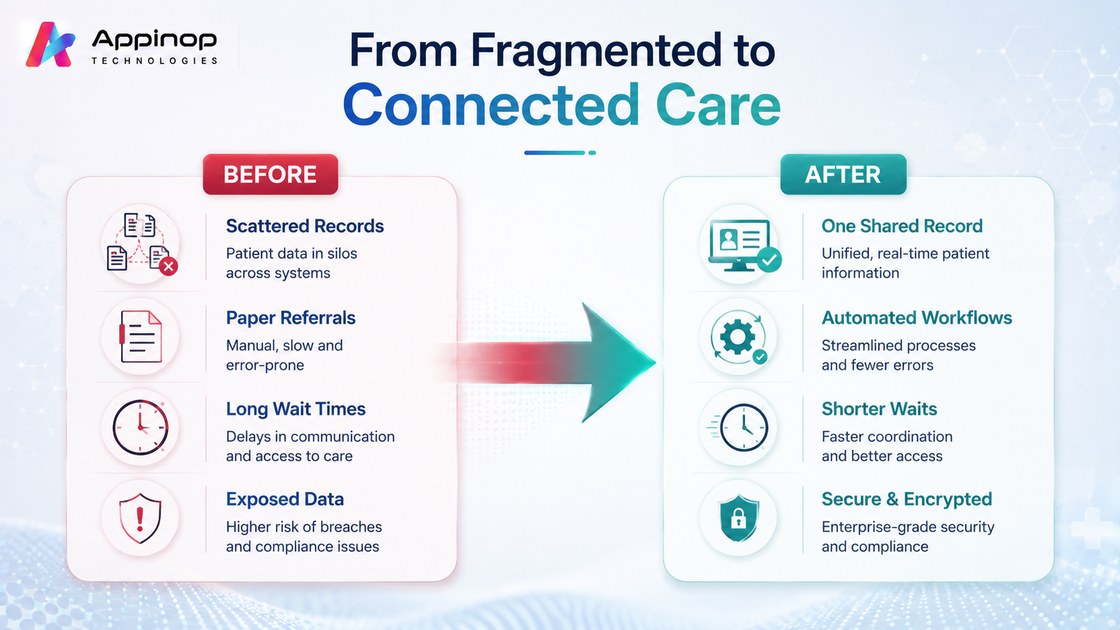
The technology stack that powers it
Sustainable transformation is not one piece of software, it is a connected ecosystem where data moves securely between clinical, operational, and patient-facing systems. Deploy tools in isolation and you simply create new data silos. The architecture below is what a modern Australian health platform looks like when it is built to work as one.
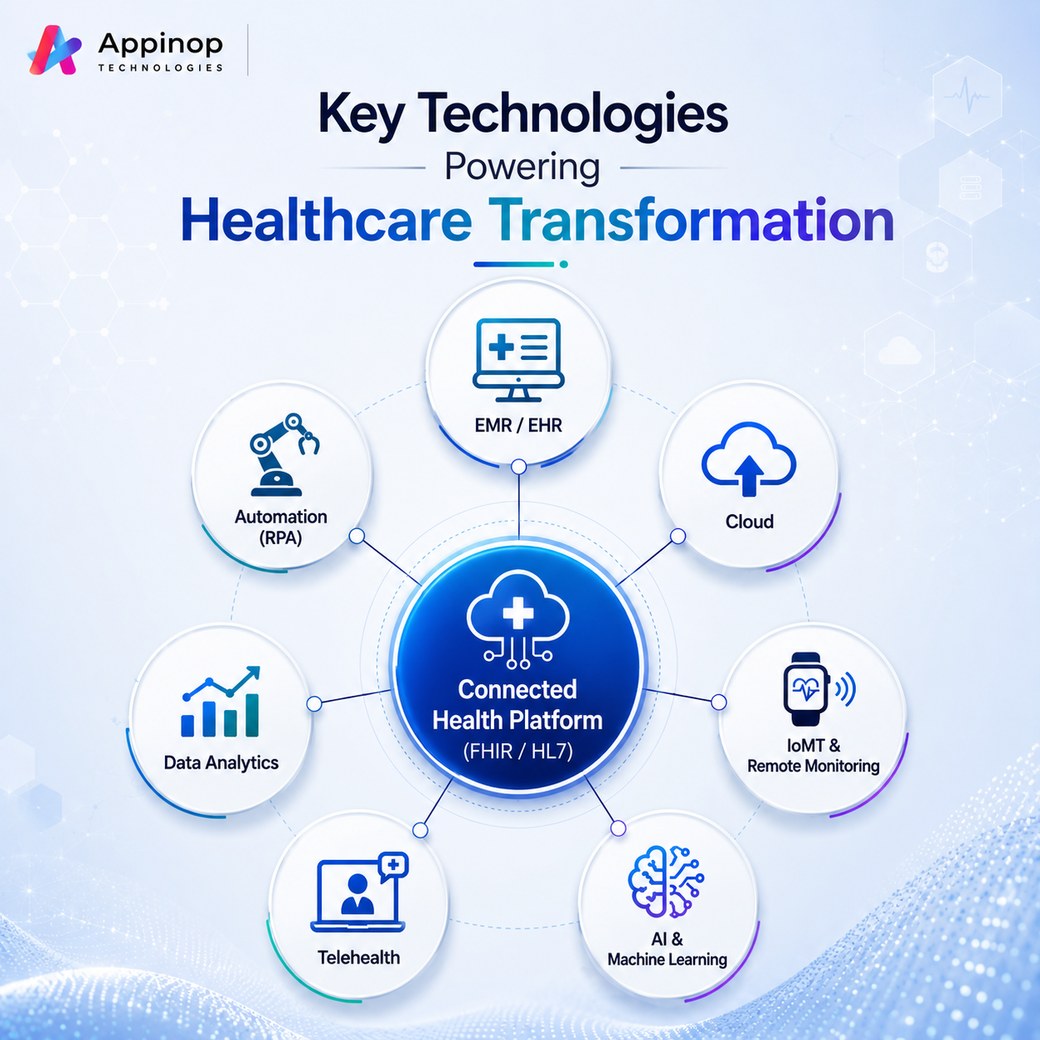
The value is not in any one of these tools, it is in connecting them. Here is what each layer does and why it matters in the Australian context.
Electronic medical records (EMR and EHR)
The record is the clinical source of truth. A modern EMR replaces paper and disconnected local databases with a single, structured patient history that every authorised clinician can see. The goal is not simply to store data but to make it usable at the point of care: allergies, medications, results, and care plans available instantly during a consult or a handover, rather than reconstructed from memory and loose referral letters.
Interoperability layer (FHIR and HL7)
This is the piece most transformations underinvest in, and it is the one that decides whether everything else works. FHIR and HL7 are the standards that let a hospital system, a pathology lab, a GP practice, and the national My Health Record exchange structured data safely. Without a strong interoperability layer, each new tool becomes another silo. With it, data flows across the whole care journey, which is the entire point of transformation.
Cloud infrastructure
Secure, scalable cloud hosting underpins everything above it. It lets a provider scale capacity with demand, recover quickly from incidents, and adopt new services without buying and maintaining physical servers. For Australian healthcare, the key is choosing cloud architecture and data residency that satisfy privacy and security obligations from the outset.
Internet of Medical Things (IoMT) and remote monitoring
Connected devices, wearables, home sensors, and bedside monitors, stream continuous data from outside the clinic walls. This is what makes proactive, preventive care possible: spotting a deteriorating patient at home before they need an emergency admission, and easing the load on a stretched workforce by reducing avoidable visits.
Artificial intelligence and machine learning
AI is moving from pilot to production in Australian healthcare. In imaging and diagnostics it flags anomalies earlier and more consistently; in operations it forecasts demand and optimises rostering and bed capacity; in administration it drafts documentation and automates triage. The caveat is regulatory: certain AI tools count as software as a medical device and require TGA approval, so clinical AI must be built with compliance in mind.
Telehealth and patient-facing apps
Telehealth moved permanently into the mainstream, and more than 40% of Australians now use it in a given year. Beyond video consults, patient apps handle bookings, results, reminders, and secure messaging, extending specialist access to rural and remote communities that have far fewer clinicians per head than the cities.
Data analytics and automation
Advanced analytics turns the data these systems generate into decisions: population health trends, service utilisation, and outcome tracking for value-based funding. Alongside it, robotic process automation removes the repetitive admin, scheduling, claims, data entry, that quietly consumes clinical hours and inflates the cost of every episode of care.
Where it creates value across the health ecosystem
Transformation looks different depending on who you are, and the highest-return use cases vary by setting. Here is where it pays off across the Australian ecosystem.
The common thread is that value comes from connection. A diagnostic result is worth far more when it flows automatically into a hospital record and a patient app, and an aged care alert matters only if it reaches the right clinician in time. Isolated tools deliver isolated gains, connected systems compound them.
The benefits at a glance
When the pieces connect, the payoff shows up across every part of the organisation, clinical, operational, financial, and human.
A practical transformation roadmap
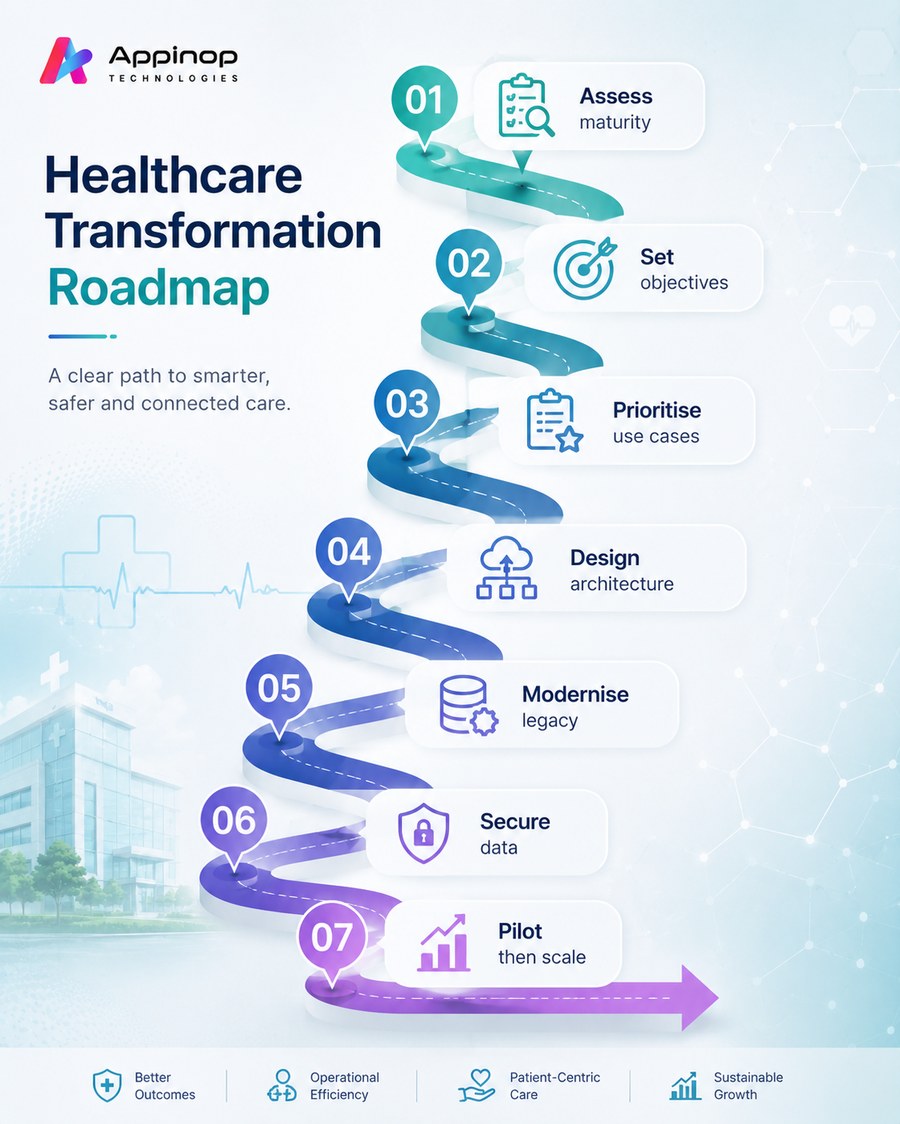
The programs that succeed are sequenced deliberately, each phase reducing the risk of the next. A proven path for an Australian provider looks like this:
What it costs to transform
Cost depends entirely on scope, so treat any single figure with suspicion. The real drivers are the number of legacy systems to integrate, the complexity of data migration, the compliance overhead for FHIR and TGA alignment, and how much AI and analytics you layer on top. As a broad, indicative guide, most Australian initiatives fall along these lines:
| Scope | Indicative investment (AUD) | Typical timeline |
|---|---|---|
| Single clinic or practice | from tens of thousands | 3 to 6 months |
| Multi-site provider | low hundreds of thousands | 6 to 14 months |
| Hospital network | several hundred thousand and up | 14 to 24 months |
These are starting reference points, not a quote. The only way to know your real number is to scope your systems, compliance needs, and goals. We do that assessment and give you a clear, itemised estimate with the expected return.
The biggest barriers, and how to beat them
Most delays trace back to a handful of predictable failure points. Naming them early and resourcing against them is what keeps a program on schedule.
Australian compliance you must design for
In Australian healthcare, compliance is not a checklist bolted on at the end. It is an architectural constraint that shapes vendor choice, data flows, and system design from the first day. These are the obligations that matter most:
| Requirement | Why it matters |
|---|---|
| Privacy Act 1988 + APPs | Governs how personal and health information is collected, used, secured, and disclosed. |
| My Health Records Act 2012 | Sets access and notification rules for the national My Health Record system. |
| TGA (software as a medical device) | Certain AI and clinical software is a regulated medical device needing approval. |
| ADHA standards | National conformance requirements for digital health products and services. |
| FHIR and HL7 | The standards for structured, interoperable health data exchange. |
| ISO 27001 and SOC 2 | Benchmarks for information security and for vendors handling patient data in the cloud. |
| State-specific rules | Jurisdictional variations in consent and data handling on top of federal law. |
The practical takeaway: choose a partner who designs encryption, role-based access, and audit logging into the core, so systems pass assessment without slowing delivery.
Build, buy, or modernise?
There is no single right answer, only the right fit for your situation. The three paths trade speed, control, and cost differently.
Most successful programs blend all three: buy the commodity, modernise the workable core, and build custom only where it creates real advantage.
What transformation looks like in practice
This is not a future scenario, it is already happening across the country. A few live examples show the direction of travel.
- The national My Health Record: Australia's shared digital record connects patients and providers to a common history, and it is being modernised and expanded, with providers increasingly required to upload key results and reports. It is the clearest example of interoperability at national scale.
- Permanent telehealth: what began as an emergency measure is now embedded in everyday care, with more than 40% of Australians using telehealth in a year and specialist access reaching regional and remote communities that never had it.
- Electronic prescribing: digital scripts have largely replaced paper across the country, a textbook case of digitalisation that removed friction for patients, pharmacists, and prescribers alike.
- AI in diagnostics: radiology and pathology providers are adopting AI to flag findings earlier and more consistently, shortening the path from scan to diagnosis.
- Remote monitoring in aged care: sensors and wearables are keeping older Australians safe at home, catching deterioration early and reducing avoidable hospital admissions.
Each of these started narrow, proved its value, and scaled, which is exactly the pattern a new program should follow.
How to measure whether it is working
Transformation without measurement is just spending. Tie every initiative to metrics you track before and after, so you can prove value and decide what to scale. The ones that matter most:
- Clinical outcomes: readmission rates, time to diagnosis, and adverse events.
- Operational efficiency: wait times, length of stay, and clinician hours returned from reduced admin.
- Financial impact: cost per episode of care, claims turnaround, and return on the technology investment.
- Experience: patient satisfaction and, just as important, clinician satisfaction and adoption rates.
- Security and compliance: audit pass rates, incident response times, and breach exposure.
Agreeing these measures up front is what separates a program that keeps earning budget from one that quietly stalls.
Common mistakes that derail transformation
The external barriers above are real, but many programs are undone by avoidable, self-inflicted errors. Watch for these:
- Buying technology before defining the problem. Starting with a product rather than a clinical or operational outcome is the fastest way to spend a budget and change nothing. Define the outcome first, then choose the tool.
- Treating interoperability as optional. Skipping the FHIR and HL7 groundwork to ship faster simply creates the next silo, and a more expensive one to unpick later.
- Leaving clinicians out of design. Tools built without frontline input get quietly abandoned. The people who will use a system every day should shape it.
- Bolting on compliance at the end. Privacy, TGA, and security requirements are architectural, not a final audit. Retrofitting them is slow, costly, and risky.
- Going big-bang. Trying to transform everything at once maximises risk. Pilot narrow, prove value, then scale from evidence.
- Ignoring change management. The technology is often the easy part. Training, workflow redesign, and clinician buy-in determine whether adoption actually happens.
None of these are technical problems, they are planning and leadership problems, which is why the right delivery partner matters as much as the right technology.
Building it with the right partner
Healthcare transformation lives or dies on interoperability, security, and compliance, which is where generic builds stall. Appinop delivers custom healthcare software development designed around FHIR, HL7, and the Privacy Act, with the encryption, access control, and audit trails built into the core. We pair that with AI development for diagnostics and predictive care, AI integration into your existing systems, and full custom software development, so your platform is compliant, connected, and built to scale from one site to a network.
- Australia's ageing population, workforce shortages, and rising cyber risk make transformation urgent, not optional.
- Real transformation connects EMR, interoperability, cloud, IoMT, AI, and telehealth into one platform, not isolated tools.
- Design for compliance (Privacy Act, TGA, FHIR, My Health Records Act) from day one, not as an afterthought.
- Start with a high-impact pilot, prove the value, then scale, and choose a partner who builds security in by default.
Ready to Build Your Project?
Get expert consultation from our team of 50+ specialists.
Related Topics

Experts on staff
Years building products
UAE · India
Clients delivered globally
Frequently Asked Questions
Related Articles
Ready to Start Your Project?
Our team of 50+ experts is ready to help you build exceptional digital products.