
Fintech App Development Cost: Process, Features & Compliance Guide
The complete global playbook for building a fintech app: types, features, a six-region compliance map (US, UK, EU, Australia, India, Gulf), BaaS vs own-license strategy, the real development process, and honest costs from $25,000 to $200,000+.
Fintech is where software eats the largest industry on earth, and where a wrong compliance decision can kill a funded startup before launch. This guide is the complete playbook for building a fintech app: the types that make money, the features regulators and users both demand, a region-by-region compliance map covering the US, UK, EU, Australia, India, and the Gulf, the real development process, and honest costs. It is written for founders and businesses building for global markets, because fintech is never a one-country product for long.
The market: too big to ignore, too regulated to wing
The global fintech market passed $459 billion in 2026, growing at roughly 16% a year, and the World Bank's Findex still counts over a billion adults without full access to financial services, the demand side of every wallet, lending, and remittance app yet to be built. Digital wallets are heading toward six billion users this decade, embedded finance is pushing payments and credit into every non-financial app, and AI has moved from fintech buzzword to the fraud, credit, and support engine of every serious product.
The anatomy of a fintech app: where the money actually flows
Before types and features, hold the whole machine in one picture. Every fintech product, wallet, neobank, lender, or trading app, is the same four layers wearing different clothes:
Founders obsess over the top layer because it is what users see; regulators, banks, and acquirers judge you on the bottom two. Every section that follows maps onto this stack.
Types of fintech apps, and what each really involves
| Type | Known examples | What founders underestimate |
|---|---|---|
| Digital wallet / payments | Apple Pay, STC Pay, Paytm | Money transmitter licensing per market; fraud eats careless margins |
| Neobank / digital banking | Revolut, Monzo, N26 | You usually partner with a licensed bank (BaaS) long before owning a license |
| Lending / BNPL | SoFi, Klarna, Tabby | Credit models and collections are the business; the app is the wrapper |
| Investment / trading | Robinhood, eToro, Groww | Broker licensing or partnerships, market data fees, real-time engineering |
| Crypto exchange / wallet | Binance, Coinbase | Custody security and per-country licensing; see our exchange guide |
| Personal finance / wealth | Mint-class apps, Betterment | Bank data aggregation (Plaid-style) and the trust to hold it |
| Insurtech | Lemonade, Policybazaar | Underwriting partnerships and per-state/per-country insurance rules |
| Remittance / cross-border | Wise, Remitly | Licensing on both ends of every corridor plus FX and settlement rails |
| SME finance / B2B | Brex, Airwallex, Tide | Slower sales, higher LTV; accounting and payroll integrations decide wins |
| RegTech / infrastructure | Onfido, ComplyAdvantage | Selling to fintechs beats being one: B2B picks-and-shovels economics |
The features that decide adoption
Every fintech product stands on the same feature spine, and users now treat most of it as table stakes: instant onboarding with digital KYC (document plus liveness checks), biometric login with MFA, a dashboard that answers "where is my money" in one glance, payments and transfers with real-time status, spending analytics and budgeting, smart notifications for every money movement, and an AI assistant that actually resolves issues. On the admin side, the unglamorous half decides survival: KYC review queues, AML monitoring dashboards, transaction audit trails, role-based access, fraud scoring, and the reports your regulator and your board will both demand. Multi-language and local payment rails (UPI in India, PayID in Australia, SEPA in Europe, mada in Saudi) are what separate a global product from a translated one.
The compliance passport: six regions, one table
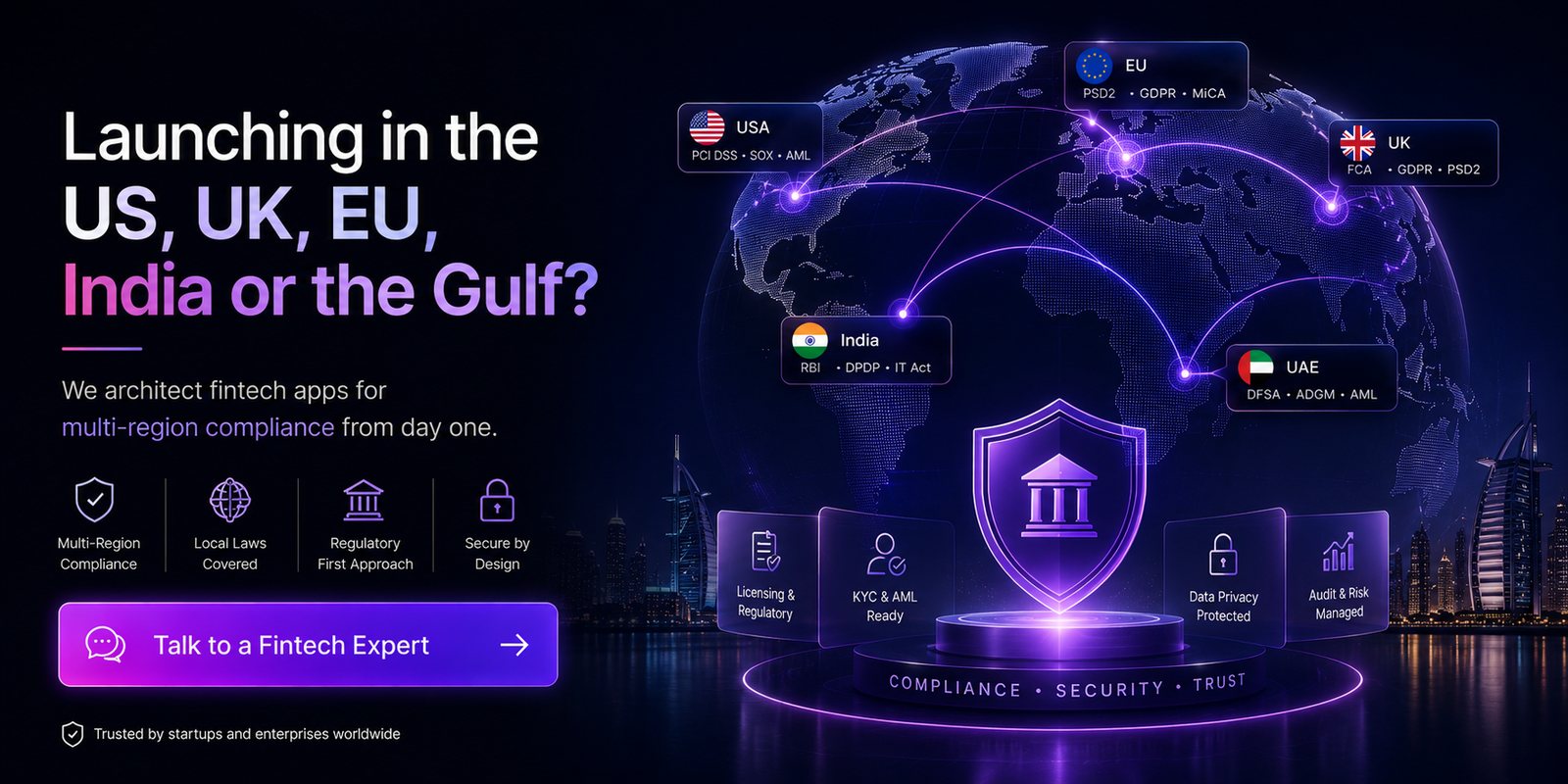
This is the section most guides skip or write for one country. Fintech regulation decides your architecture, your timeline, and sometimes your entire business model, and it changes at every border:
| Region | Key regulators & licenses | What it means for your build |
|---|---|---|
| 🇺🇸 United States | State-by-state money transmitter licenses, federal oversight (FinCEN, CFPB, SEC/FINRA for investing), PCI DSS, GLBA | Most startups launch on a licensed BaaS or payments partner rather than collecting 50 state licenses; SOC 2 is now a sales requirement |
| 🇬🇧 United Kingdom | FCA authorization, EMI/PI licenses for payments, Open Banking standards, UK GDPR | Clear licensing tiers make the UK a common first regulated market; Open Banking APIs are mature and mandatory for account data |
| 🇪🇺 European Union | PSD2 (PSD3 incoming), EMI passporting across 27 states, GDPR, MiCA for crypto assets | One EMI license passports across the EU, the best license-to-market ratio anywhere; GDPR shapes your entire data design |
| 🇦🇺 Australia | ASIC (AFSL licensing), AUSTRAC for AML/CTF, Consumer Data Right (CDR) for open banking, Privacy Act | AFSL scoping is the critical early decision; CDR opens bank data but with strict accreditation |
| 🇮🇳 India | RBI (PA/PG authorization, NBFC for lending), UPI ecosystem via NPCI, DPDP Act for data | UPI integration is non-negotiable for consumer payments; data localization requirements shape infrastructure choices |
| 🇦🇪 Gulf (UAE & Saudi) | CBUAE, DIFC/ADGM frameworks, VARA for crypto (Dubai); SAMA, Saudi PDPL, open banking framework | Regulatory sandboxes actively court fintechs; Arabic-first UX and local rails (mada, UAE IPP) decide adoption |
Three rules that survive every border: pick your first regulated market before writing code (it dictates architecture), use licensed partners (BaaS, payment institutions) to launch years earlier than owning licenses, and design data residency per region from day one, retrofitting it is a rebuild. For crypto-touching products, our country-by-country licensing guide maps that landscape in depth.
BaaS or your own license: the decision that shapes everything
The single most consequential choice in fintech is how you access the regulated core. The honest comparison:
KYC without killing your funnel
Compliance teams and growth teams fight over one screen: onboarding. Every verification step protects you and costs you signups, so serious fintechs run risk-based tiers: light KYC (name, phone, document scan) unlocks a limited account in minutes; enhanced checks trigger only at thresholds, higher balances, larger transfers, risk flags. Design the funnel around three numbers you will watch daily: verification pass rate, time-to-first-transaction, and drop-off per step. And treat KYC vendor costs as real unit economics: identity checks are priced per verification, so a viral signup day with poor fraud filtering is an invoice, not a victory.
The development process: eight steps without the filler
The tech stack, by layer
On the AI layer: fraud detection, credit scoring, personalization, and an assistant that reads statements are now competitive baseline, and they belong behind one AI service layer with caching, cost caps, and fallbacks, the exact architecture we detail in our AI integration guide.
Security non-negotiables
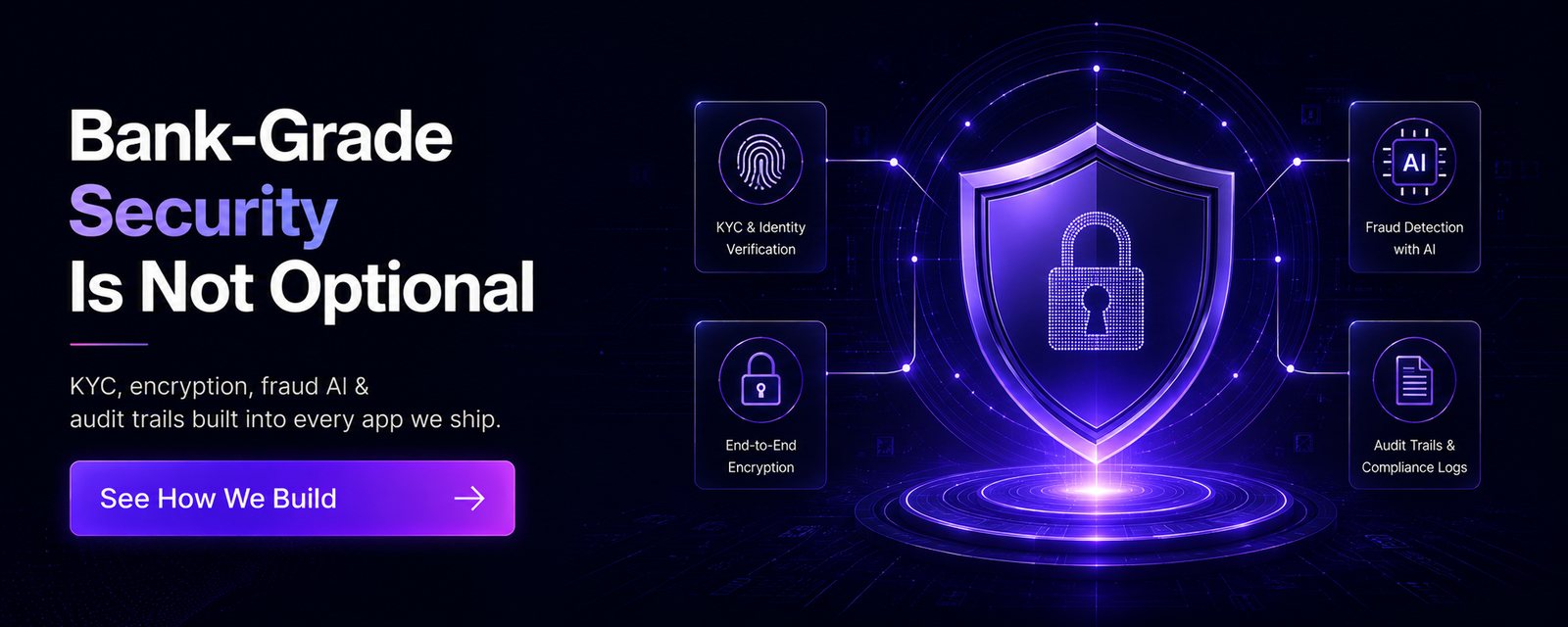
One paragraph, zero compromise: end-to-end encryption in transit and at rest, tokenization of card and account data, MFA plus biometric authentication, PCI DSS scope handled properly (usually by keeping card data with your processor), AI-driven transaction monitoring with human review queues, device fingerprinting, secure API design with strict rate limits, immutable audit logs, and penetration testing on a schedule, not once. A single breach in fintech is not an incident; it is usually the end of the company.
What a fintech app costs to build
| App type | Typical range (USD) | Timeline |
|---|---|---|
| Digital wallet / payments MVP | $25,000 - $60,000 | 3-5 months |
| Personal finance / wealth app | $25,000 - $65,000 | 3-5 months |
| Lending / BNPL platform | $50,000 - $100,000 | 5-7 months |
| Investment / trading app | $60,000 - $150,000 | 6-9 months |
| Crypto exchange | from $4,000 white label; $8,000-$25,000 custom | 1-4 months |
| Digital banking platform | $80,000 - $200,000+ | 8-12 months |
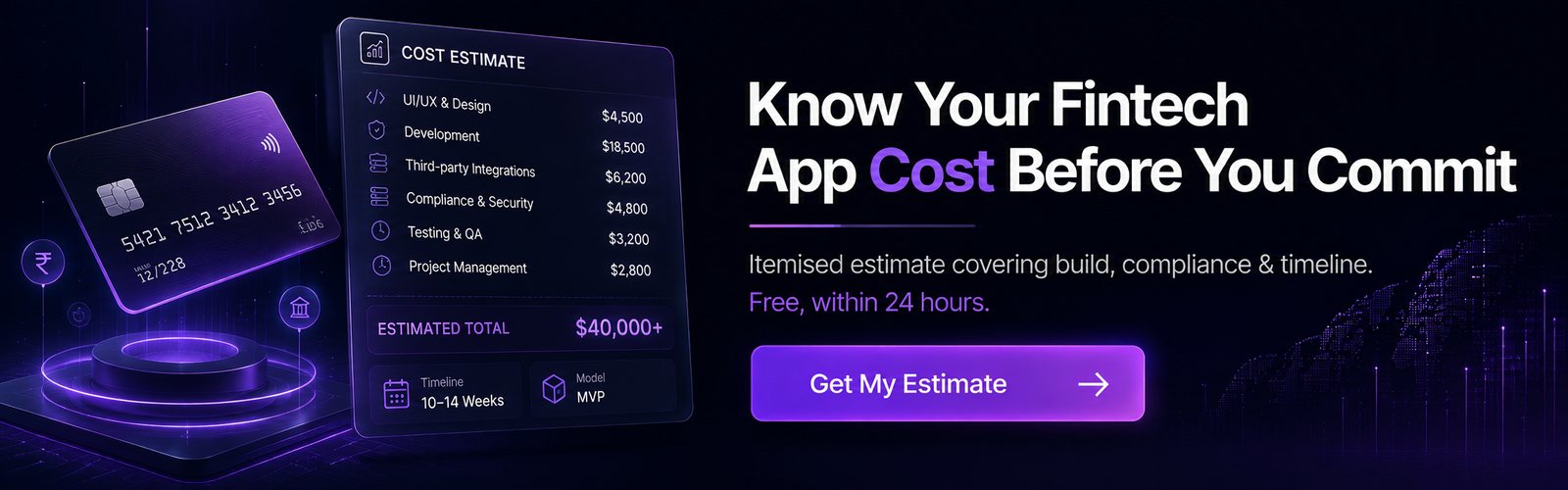
The drivers behind every range: compliance scope (one region or five), the financial backbone (BaaS fees vs direct integrations), security and audit depth, AI features, and platform count. Budget the hidden lines too: cloud and API usage, KYC per-check fees, penetration testing, app store cycles, and 15-20% of build cost annually for maintenance and regulatory updates. And note what these figures beat: the same scopes quoted by US or Australian local agencies routinely run 3 to 5 times higher.
How fintech apps make money
Seven models cover the industry, and strong products stack two or three: transaction fees (the wallet and gateway standard), interchange on card spend, subscriptions for premium tiers, lending interest and servicing fees, commissions on trades and policies, API licensing for your infrastructure (the BaaS play), and white-label licensing of the whole platform to banks and brands. The strategic rule: choose the model before the feature list, because the model decides which features are the product and which are decoration.
To make it concrete, here is the shape of wallet-app unit economics, illustrative figures, but the structure is what every investor will ask you to fill in:
Embedded finance: the B2B goldmine builders overlook
The fastest-growing fintech buyers are not fintechs: they are marketplaces adding seller payouts and wallets, SaaS platforms issuing cards and capturing interchange, retailers adding checkout credit, and gig platforms embedding instant pay. For these companies the finance feature deepens retention and adds a revenue line without becoming their identity, and for builders it means the same wallet, card, and lending architecture in this guide sells to every industry, usually with a BaaS partner carrying the license. If your ambition is a product, embedded finance is a feature roadmap; if your ambition is a business, it is also a white-label market.
The mistakes that kill fintech apps
- Compliance as a launch-week task. The teams that treat regulation as a final checkbox rebuild their architecture twice and launch a year late. A compliance owner belongs in the first planning meeting.
- Fraud controls after the fraud. Fraud finds new fintechs within days of launch. Velocity limits, device fingerprinting, and manual review queues must exist on day one, tuned looser, but existing.
- One-region data design. Hardcoding a single cloud region works until your second market demands residency, then it is a re-platform. Regional partitioning is cheap early and brutal late.
- Ignoring chargeback and dispute economics. Disputes carry fees, labor, and network penalties at thresholds. Products that make disputes rare (clear descriptors, instant support, easy refunds) protect margins invisibly.
- Trusting one partner with your existence. Fintechs have died from a single partner bank or processor exiting the business. Abstract your rails behind your own interfaces and know your migration path before you need it.
- Shipping trust-breaking bugs. A social app survives a crash; a wallet showing the wrong balance for an hour loses users permanently. Ledger correctness and reconciliation deserve the paranoia usually reserved for security.
What is shaping fintech now
Five currents worth building toward rather than reacting to: embedded finance, where every retailer, marketplace, and SaaS adds payments and credit (the biggest B2B opportunity for builders); AI-native banking, where fraud, credit, support, and personalization run on models rather than rules; real-time payment rails (UPI, PIX, FedNow-class systems) becoming the default consumer expectation; stablecoins and tokenized assets moving from crypto niche to settlement infrastructure, with MiCA-style rules making them bankable; and super-app consolidation, where wallets absorb commerce and services, the model we mapped in our Gojek super app guide.
Proof, not promises: our fintech track record
We build fintech for a living, not as a blog topic. Appinop has delivered crypto exchanges serving live markets (including Flitpay and BitDelta in our portfolio), wallets, and trading platforms, work our clients describe in verified Clutch reviews: "We're most impressed with Appinop Technologies' technical expertise and ability to understand our needs," from the manager of a financial services company we built a cryptocurrency exchange platform for. The full stack is in-house: fintech app development, eWallet development, loan and lending platforms, crypto exchange development, and AI integration for the fraud and intelligence layer.
Ready to Build Your Project?
Get expert consultation from our team of 50+ specialists.
Related Topics

Experts on staff
Years building products
UAE · India
Clients delivered globally
Frequently Asked Questions
Related Articles
Ready to Start Your Project?
Our team of 50+ experts is ready to help you build exceptional digital products.